Automate YouTube thumbnail creation & social publishing with Templated.io & Blotato
💥 Automate YouTube thumbnail creation from video links (with templated.io)
Who is this for?
This workflow is designed for content creators, YouTubers, and automation enthusiasts who want to automatically generate stunning YouTube thumbnails and streamline their publishing workflow — all within n8n.
If you regularly post videos and spend hours designing thumbnails manually, this automation is built for you.
What problem is this workflow solving?
Creating thumbnails is time-consuming — yet crucial for video performance.
This workflow completely automates that process:
- No more manual design.
- No more downloading screenshots.
- No more repetitive uploads.
In less than 2 minutes, you can refresh your entire YouTube thumbnail library and make your channel look brand new.
What this workflow does
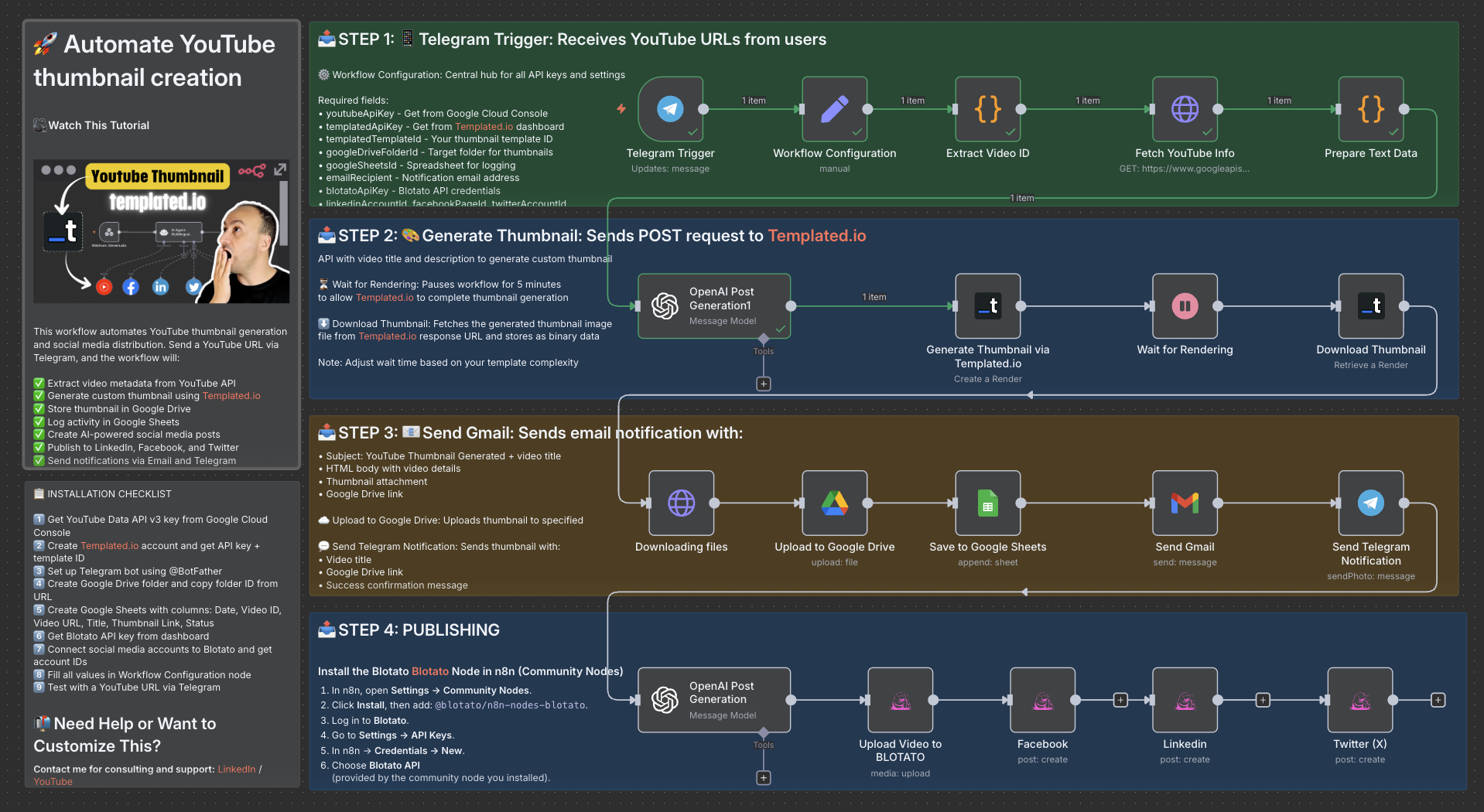
Once activated, this workflow can:
✅ Receive YouTube video links via Telegram
✅ Extract metadata (title, description, channel info) via YouTube API
✅ Generate a custom thumbnail automatically using Templated.io
✅ Upload the new thumbnail to Google Drive
✅ Log data in Google Sheets
✅ Send email and Telegram notifications when ready
✅ Create and publish AI-generated social posts on LinkedIn, Facebook, and Twitter via Blotato
Bonus: You can re-create dozens of YouTube covers in minutes — saving up to 5 hours per week and around $500/month in manual design effort.
Setup
1️⃣ Get a YouTube Data API v3 key from Google Cloud Console
2️⃣ Create a Templated.io account and get your API key + template ID
3️⃣ Set up a Telegram bot using @BotFather
4️⃣ Create a Google Drive folder and copy the folder ID
5️⃣ Create a Google Sheet with columns: Date, Video ID, Video URL, Title, Thumbnail Link, Status
6️⃣ Get your Blotato API key from the dashboard
7️⃣ Connect your social media accounts to Blotato
8️⃣ Fill all credentials in the Workflow Configuration node
9️⃣ Test by sending a YouTube URL to your Telegram bot
How to customize this workflow
- Replace the Templated.io template ID with your own custom thumbnail layout
- Modify the OpenAI node prompts to change text tone or style
- Add or remove social platforms in the Blotato section
- Adjust the wait time (default: 5 minutes) based on template complexity
- Localize or translate the generated captions as needed
Expected Outcome
With one Telegram message, you’ll receive:
- A professional custom thumbnail
- An instant email + Telegram notification
- A Google Drive link with your ready-to-use design
And your social networks will be automatically updated — no manual uploads.
Credits
- Thumbnail generation powered by Templated.io
- Social publishing powered by Blotato
- Automation orchestrated via n8n
👋 Need help or want to customize this?
📩 Contact: LinkedIn
📺 YouTube: @DRFIRASS
🚀 Workshops: Mes Ateliers n8n
🎥 Watch This Tutorial
📄 Documentation: Notion Guide
Need help customizing?
Contact me for consulting and support : Linkedin / Youtube / 🚀 Mes Ateliers n8n
Automate YouTube Thumbnail Creation & Social Publishing
This n8n workflow streamlines the process of generating YouTube thumbnails, publishing them to Google Drive, and announcing new content on Telegram and via email. It leverages AI to create engaging thumbnails based on video titles and automates the distribution across multiple platforms.
What it does
This workflow automates the following steps:
- Triggers on Telegram Message: Listens for incoming messages in a configured Telegram chat.
- Extracts Video Title: Parses the Telegram message to get the YouTube video title.
- Generates Thumbnail with AI: Uses OpenAI to generate a compelling thumbnail image based on the video title.
- Uploads to Google Drive: Saves the generated thumbnail image to a specified folder in Google Drive.
- Notifies on Telegram: Sends a confirmation message with the new thumbnail to the Telegram chat.
- Sends Email Notification: Dispatches an email with the thumbnail and relevant information using Gmail.
- Logs to Google Sheets: Records details about the generated thumbnail and video in a Google Sheet.
- Introduces a Delay: Pauses the workflow for a specified duration (e.g., to allow for manual review or to space out posts).
- Performs HTTP Request: Executes a generic HTTP request, likely for further integration or notification.
Prerequisites/Requirements
To use this workflow, you will need:
- n8n Instance: A running n8n instance.
- Telegram Bot: A Telegram bot token and a chat ID to trigger the workflow and send notifications.
- OpenAI API Key: An OpenAI account and API key for thumbnail generation.
- Google Drive Account: A Google account with access to Google Drive for storing thumbnails.
- Gmail Account: A Google account with access to Gmail for sending email notifications.
- Google Sheets Account: A Google account with access to Google Sheets for logging data.
Setup/Usage
- Import the Workflow: Import the provided JSON into your n8n instance.
- Configure Credentials:
- Set up Telegram credentials for the "Telegram Trigger" and "Telegram" nodes.
- Configure OpenAI credentials for the "OpenAI" node.
- Set up Google OAuth credentials for the "Google Drive", "Gmail", and "Google Sheets" nodes.
- Customize Nodes:
- Telegram Trigger: Ensure the "Chat ID" is correctly configured for your Telegram bot.
- Edit Fields (Set): Adjust any data transformation logic as needed for your specific video title extraction.
- OpenAI: Configure the prompt for thumbnail generation to best suit your content style.
- Google Drive: Specify the target folder ID where thumbnails should be uploaded.
- Telegram: Customize the message content and target chat ID for notifications.
- Gmail: Configure the recipient email, subject, and body for the email notification.
- Google Sheets: Set the Spreadsheet ID and Sheet Name for logging.
- Wait: Adjust the delay duration if necessary.
- HTTP Request: Configure the URL and any headers/body for the final HTTP request.
- Activate the Workflow: Once configured, activate the workflow. It will now listen for messages in your specified Telegram chat.
- Trigger the Workflow: Send a Telegram message containing your YouTube video title to your configured bot to initiate the thumbnail creation and publishing process.
Related Templates
Auto-create TikTok videos with VEED.io AI avatars, ElevenLabs & GPT-4
💥 Viral TikTok Video Machine: Auto-Create Videos with Your AI Avatar --- 🎯 Who is this for? This workflow is for content creators, marketers, and agencies who want to use Veed.io’s AI avatar technology to produce short, engaging TikTok videos automatically. It’s ideal for creators who want to appear on camera without recording themselves, and for teams managing multiple brands who need to generate videos at scale. --- ⚙️ What problem this workflow solves Manually creating videos for TikTok can take hours — finding trends, writing scripts, recording, and editing. By combining Veed.io, ElevenLabs, and GPT-4, this workflow transforms a simple Telegram input into a ready-to-post TikTok video featuring your AI avatar powered by Veed.io — speaking naturally with your cloned voice. --- 🚀 What this workflow does This automation links Veed.io’s video-generation API with multiple AI tools: Analyzes TikTok trends via Perplexity AI Writes a 10-second viral script using GPT-4 Generates your voiceover via ElevenLabs Uses Veed.io (Fabric 1.0 via FAL.ai) to animate your avatar and sync the lips to the voice Creates an engaging caption + hashtags for TikTok virality Publishes the video automatically via Blotato TikTok API Logs all results to Google Sheets for tracking --- 🧩 Setup Telegram Bot Create your bot via @BotFather Configure it as the trigger for sending your photo and theme Connect Veed.io Create an account on Veed.io Get your FAL.ai API key (Veed Fabric 1.0 model) Use HTTPS image/audio URLs compatible with Veed Fabric Other APIs Add Perplexity, ElevenLabs, and Blotato TikTok keys Connect your Google Sheet for logging results --- 🛠️ How to customize this workflow Change your Avatar: Upload a new image through Telegram, and Veed.io will generate a new talking version automatically. Modify the Script Style: Adjust the GPT prompt for tone (educational, funny, storytelling). Adjust Voice Tone: Tweak ElevenLabs stability and similarity settings. Expand Platforms: Add Instagram, YouTube Shorts, or X (Twitter) posting nodes. Track Performance: Customize your Google Sheet to measure your most successful Veed.io-based videos. --- 🧠 Expected Outcome In just a few seconds after sending your photo and theme, this workflow — powered by Veed.io — creates a fully automated TikTok video featuring your AI avatar with natural lip-sync and voice. The result is a continuous stream of viral short videos, made without cameras, editing, or effort. --- ✅ Import the JSON file in n8n, add your API keys (including Veed.io via FAL.ai), and start generating viral TikTok videos starring your AI avatar today! 🎥 Watch This Tutorial --- 📄 Documentation: Notion Guide Need help customizing? Contact me for consulting and support : Linkedin / Youtube
 By Dr. Firas
Automate Dutch Public Procurement Data Collection with TenderNed
TenderNed Public Procurement What This Workflow Does This workflow automates the collection of public procurement data from TenderNed (the official Dutch tender platform). It: Fetches the latest tender publications from the TenderNed API Retrieves detailed information in both XML and JSON formats for each tender Parses and extracts key information like organization names, titles, descriptions, and reference numbers Filters results based on your custom criteria Stores the data in a database for easy querying and analysis Setup Instructions This template comes with sticky notes providing step-by-step instructions in Dutch and various query options you can customize. Prerequisites TenderNed API Access - Register at TenderNed for API credentials Configuration Steps Set up TenderNed credentials: Add HTTP Basic Auth credentials with your TenderNed API username and password Apply these credentials to the three HTTP Request nodes: "Tenderned Publicaties" "Haal XML Details" "Haal JSON Details" Customize filters: Modify the "Filter op ..." node to match your specific requirements Examples: specific organizations, contract values, regions, etc. How It Works Step 1: Trigger The workflow can be triggered either manually for testing or automatically on a daily schedule. Step 2: Fetch Publications Makes an API call to TenderNed to retrieve a list of recent publications (up to 100 per request). Step 3: Process & Split Extracts the tender array from the response and splits it into individual items for processing. Step 4: Fetch Details For each tender, the workflow makes two parallel API calls: XML endpoint - Retrieves the complete tender documentation in XML format JSON endpoint - Fetches metadata including reference numbers and keywords Step 5: Parse & Merge Parses the XML data and merges it with the JSON metadata and batch information into a single data structure. Step 6: Extract Fields Maps the raw API data to clean, structured fields including: Publication ID and date Organization name Tender title and description Reference numbers (kenmerk, TED number) Step 7: Filter Applies your custom filter criteria to focus on relevant tenders only. Step 8: Store Inserts the processed data into your database for storage and future analysis. Customization Tips Modify API Parameters In the "Tenderned Publicaties" node, you can adjust: offset: Starting position for pagination size: Number of results per request (max 100) Add query parameters for date ranges, status filters, etc. Add More Fields Extend the "Splits Alle Velden" node to extract additional fields from the XML/JSON data, such as: Contract value estimates Deadline dates CPV codes (procurement classification) Contact information Integrate Notifications Add a Slack, Email, or Discord node after the filter to get notified about new matching tenders. Incremental Updates Modify the workflow to only fetch new tenders by: Storing the last execution timestamp Adding date filters to the API query Only processing publications newer than the last run Troubleshooting No data returned? Verify your TenderNed API credentials are correct Check that you have setup youre filter proper Need help setting this up or interested in a complete tender analysis solution? Get in touch 🔗 LinkedIn – Wessel Bulte
 By Wessel Bulte
Automate invoice processing with OCR, GPT-4 & Salesforce opportunity creation
PDF Invoice Extractor (AI) End-to-end pipeline: Watch Drive ➜ Download PDF ➜ OCR text ➜ AI normalize to JSON ➜ Upsert Buyer (Account) ➜ Create Opportunity ➜ Map Products ➜ Create OLI via Composite API ➜ Archive to OneDrive. --- Node by node (what it does & key setup) 1) Google Drive Trigger Purpose: Fire when a new file appears in a specific Google Drive folder. Key settings: Event: fileCreated Folder ID: google drive folder id Polling: everyMinute Creds: googleDriveOAuth2Api Output: Metadata { id, name, ... } for the new file. --- 2) Download File From Google Purpose: Get the file binary for processing and archiving. Key settings: Operation: download File ID: ={{ $json.id }} Creds: googleDriveOAuth2Api Output: Binary (default key: data) and original metadata. --- 3) Extract from File Purpose: Extract text from PDF (OCR as needed) for AI parsing. Key settings: Operation: pdf OCR: enable for scanned PDFs (in options) Output: JSON with OCR text at {{ $json.text }}. --- 4) Message a model (AI JSON Extractor) Purpose: Convert OCR text into strict normalized JSON array (invoice schema). Key settings: Node: @n8n/n8n-nodes-langchain.openAi Model: gpt-4.1 (or gpt-4.1-mini) Message role: system (the strict prompt; references {{ $json.text }}) jsonOutput: true Creds: openAiApi Output (per item): $.message.content → the parsed JSON (ensure it’s an array). --- 5) Create or update an account (Salesforce) Purpose: Upsert Buyer as Account using an external ID. Key settings: Resource: account Operation: upsert External Id Field: taxid_c External Id Value: ={{ $json.message.content.buyer.tax_id }} Name: ={{ $json.message.content.buyer.name }} Creds: salesforceOAuth2Api Output: Account record (captures Id) for downstream Opportunity. --- 6) Create an opportunity (Salesforce) Purpose: Create Opportunity linked to the Buyer (Account). Key settings: Resource: opportunity Name: ={{ $('Message a model').item.json.message.content.invoice.code }} Close Date: ={{ $('Message a model').item.json.message.content.invoice.issue_date }} Stage: Closed Won Amount: ={{ $('Message a model').item.json.message.content.summary.grand_total }} AccountId: ={{ $json.id }} (from Upsert Account output) Creds: salesforceOAuth2Api Output: Opportunity Id for OLI creation. --- 7) Build SOQL (Code / JS) Purpose: Collect unique product codes from AI JSON and build a SOQL query for PricebookEntry by Pricebook2Id. Key settings: pricebook2Id (hardcoded in script): e.g., 01sxxxxxxxxxxxxxxx Source lines: $('Message a model').first().json.message.content.products Output: { soql, codes } --- 8) Query PricebookEntries (Salesforce) Purpose: Fetch PricebookEntry.Id for each Product2.ProductCode. Key settings: Resource: search Query: ={{ $json.soql }} Creds: salesforceOAuth2Api Output: Items with Id, Product2.ProductCode (used for mapping). --- 9) Code in JavaScript (Build OLI payloads) Purpose: Join lines with PBE results and Opportunity Id ➜ build OpportunityLineItem payloads. Inputs: OpportunityId: ={{ $('Create an opportunity').first().json.id }} Lines: ={{ $('Message a model').first().json.message.content.products }} PBE rows: from previous node items Output: { body: { allOrNone:false, records:[{ OpportunityLineItem... }] } } Notes: Converts discount_total ➜ per-unit if needed (currently commented for standard pricing). Throws on missing PBE mapping or empty lines. --- 10) Create Opportunity Line Items (HTTP Request) Purpose: Bulk create OLIs via Salesforce Composite API. Key settings: Method: POST URL: https://<your-instance>.my.salesforce.com/services/data/v65.0/composite/sobjects Auth: salesforceOAuth2Api (predefined credential) Body (JSON): ={{ $json.body }} Output: Composite API results (per-record statuses). --- 11) Update File to One Drive Purpose: Archive the original PDF in OneDrive. Key settings: Operation: upload File Name: ={{ $json.name }} Parent Folder ID: onedrive folder id Binary Data: true (from the Download node) Creds: microsoftOneDriveOAuth2Api Output: Uploaded file metadata. --- Data flow (wiring) Google Drive Trigger → Download File From Google Download File From Google → Extract from File → Update File to One Drive Extract from File → Message a model Message a model → Create or update an account Create or update an account → Create an opportunity Create an opportunity → Build SOQL Build SOQL → Query PricebookEntries Query PricebookEntries → Code in JavaScript Code in JavaScript → Create Opportunity Line Items --- Quick setup checklist 🔐 Credentials: Connect Google Drive, OneDrive, Salesforce, OpenAI. 📂 IDs: Drive Folder ID (watch) OneDrive Parent Folder ID (archive) Salesforce Pricebook2Id (in the JS SOQL builder) 🧠 AI Prompt: Use the strict system prompt; jsonOutput = true. 🧾 Field mappings: Buyer tax id/name → Account upsert fields Invoice code/date/amount → Opportunity fields Product name must equal your Product2.ProductCode in SF. ✅ Test: Drop a sample PDF → verify: AI returns array JSON only Account/Opportunity created OLI records created PDF archived to OneDrive --- Notes & best practices If PDFs are scans, enable OCR in Extract from File. If AI returns non-JSON, keep “Return only a JSON array” as the last line of the prompt and keep jsonOutput enabled. Consider adding validation on parsing.warnings to gate Salesforce writes. For discounts/taxes in OLI: Standard OLI fields don’t support per-line discount amounts directly; model them in UnitPrice or custom fields. Replace the Composite API URL with your org’s domain or use the Salesforce node’s Bulk Upsert for simplicity.
 By Le Nguyen