Auto-create TikTok videos with VEED.io AI avatars, ElevenLabs & GPT-4
💥 Viral TikTok Video Machine: Auto-Create Videos with Your AI Avatar
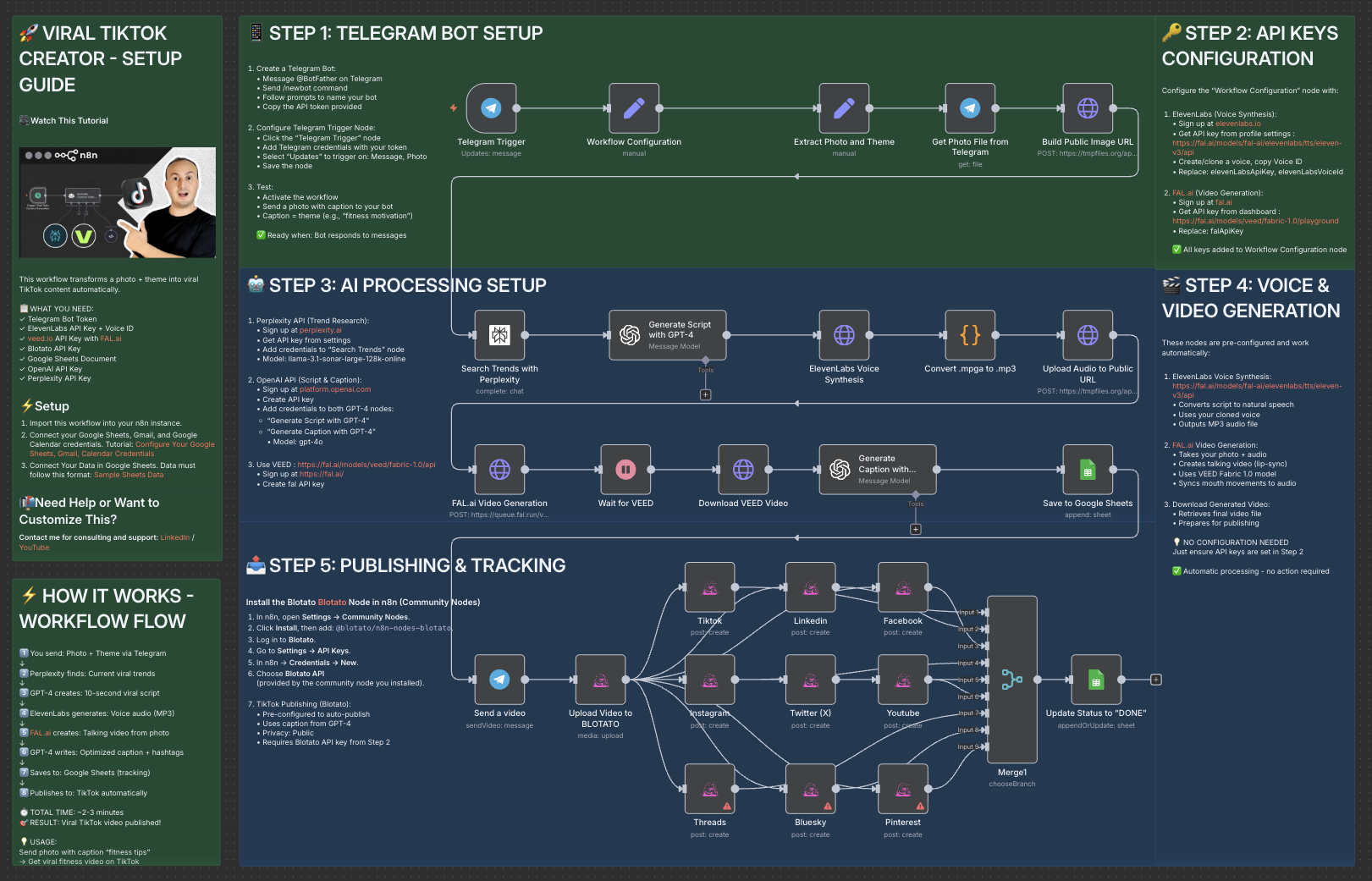
🎯 Who is this for?
This workflow is for content creators, marketers, and agencies who want to use Veed.io’s AI avatar technology to produce short, engaging TikTok videos automatically.
It’s ideal for creators who want to appear on camera without recording themselves, and for teams managing multiple brands who need to generate videos at scale.
⚙️ What problem this workflow solves
Manually creating videos for TikTok can take hours — finding trends, writing scripts, recording, and editing.
By combining Veed.io, ElevenLabs, and GPT-4, this workflow transforms a simple Telegram input into a ready-to-post TikTok video featuring your AI avatar powered by Veed.io — speaking naturally with your cloned voice.
🚀 What this workflow does
This automation links Veed.io’s video-generation API with multiple AI tools:
- Analyzes TikTok trends via Perplexity AI
- Writes a 10-second viral script using GPT-4
- Generates your voiceover via ElevenLabs
- Uses Veed.io (Fabric 1.0 via FAL.ai) to animate your avatar and sync the lips to the voice
- Creates an engaging caption + hashtags for TikTok virality
- Publishes the video automatically via Blotato TikTok API
- Logs all results to Google Sheets for tracking
🧩 Setup
-
Telegram Bot
- Create your bot via @BotFather
- Configure it as the trigger for sending your photo and theme
-
Connect Veed.io
- Create an account on Veed.io
- Get your FAL.ai API key (Veed Fabric 1.0 model)
- Use HTTPS image/audio URLs compatible with Veed Fabric
-
Other APIs
- Add Perplexity, ElevenLabs, and Blotato TikTok keys
- Connect your Google Sheet for logging results
🛠️ How to customize this workflow
- Change your Avatar: Upload a new image through Telegram, and Veed.io will generate a new talking version automatically.
- Modify the Script Style: Adjust the GPT prompt for tone (educational, funny, storytelling).
- Adjust Voice Tone: Tweak ElevenLabs stability and similarity settings.
- Expand Platforms: Add Instagram, YouTube Shorts, or X (Twitter) posting nodes.
- Track Performance: Customize your Google Sheet to measure your most successful Veed.io-based videos.
🧠 Expected Outcome
In just a few seconds after sending your photo and theme, this workflow — powered by Veed.io — creates a fully automated TikTok video featuring your AI avatar with natural lip-sync and voice.
The result is a continuous stream of viral short videos, made without cameras, editing, or effort.
✅ Import the JSON file in n8n, add your API keys (including Veed.io via FAL.ai), and start generating viral TikTok videos starring your AI avatar today!
🎥 Watch This Tutorial
📄 Documentation: Notion Guide
Need help customizing?
n8n Workflow: AI-Powered TikTok Video Creation with Veed.io, ElevenLabs, and GPT-4
This n8n workflow automates the entire process of generating engaging TikTok videos, leveraging AI for content creation, voice synthesis, and video production. It's designed to streamline the workflow for content creators looking to rapidly produce short-form video content with AI avatars.
What it does
This workflow orchestrates several AI services to create TikTok videos:
- Triggers from Telegram: The workflow is initiated by a message received in a configured Telegram chat.
- Generates Video Script with GPT-4: It takes the Telegram message as input and uses OpenAI (likely GPT-4) to generate a video script.
- Synthesizes Voice-over with ElevenLabs: The generated script is then sent to ElevenLabs to create a natural-sounding voice-over.
- Generates AI Avatar Video with Veed.io: The voice-over and potentially other parameters are passed to Veed.io to produce a video featuring an AI avatar speaking the script.
- Notifies via Telegram: Upon successful video creation (or failure), the workflow sends a notification back to the Telegram chat.
- Logs to Google Sheets: Key details of the video creation process, such as the script, voice-over URL, and video URL, are logged into a Google Sheet for tracking and record-keeping.
- Manages Flow with Merge and Wait: The workflow utilizes merge and wait nodes to ensure proper sequencing and handling of asynchronous operations between the various AI services.
Prerequisites/Requirements
To use this workflow, you will need:
- n8n Instance: A running n8n instance.
- Telegram Bot Token: A Telegram bot configured and its token for triggering the workflow and receiving notifications.
- OpenAI API Key: An API key for OpenAI (likely with access to GPT-4 or a similar model for script generation).
- ElevenLabs API Key: An API key for ElevenLabs for text-to-speech voice synthesis.
- Veed.io API Key: An API key for Veed.io for AI avatar video generation.
- Google Sheets Account: A Google Sheets account and a specific spreadsheet configured for logging.
- Perplexity API Key (Optional): A Perplexity API key might be used for additional content generation or research, depending on the specific configuration of that node.
Setup/Usage
- Import the Workflow: Download the provided JSON and import it into your n8n instance.
- Configure Credentials:
- Set up a Telegram API credential using your bot token.
- Set up an OpenAI API credential with your API key.
- Set up an ElevenLabs API credential with your API key.
- Set up a Veed.io API credential with your API key.
- Set up a Google Sheets API credential.
- (Optional) Set up a Perplexity API credential.
- Configure Nodes:
- Telegram Trigger: Select your Telegram credential.
- OpenAI: Configure the model (e.g.,
gpt-4) and prompt for script generation, referencing the incoming Telegram message. - ElevenLabs: Configure the voice and input the generated script from the OpenAI node.
- Veed.io: Configure the AI avatar, background, and input the ElevenLabs voice-over URL.
- Google Sheets: Specify your spreadsheet ID, sheet name, and map the data fields (script, voice-over URL, video URL, etc.) to the respective columns.
- Telegram (Notification): Configure the chat ID to send notifications to and customize the success/failure messages.
- Activate the Workflow: Once all credentials and nodes are configured, activate the workflow.
Now, whenever you send a message to your configured Telegram bot, the workflow will automatically generate a TikTok video and notify you of its progress and completion.
Related Templates
Automate invoice processing with OCR, GPT-4 & Salesforce opportunity creation
PDF Invoice Extractor (AI) End-to-end pipeline: Watch Drive ➜ Download PDF ➜ OCR text ➜ AI normalize to JSON ➜ Upsert Buyer (Account) ➜ Create Opportunity ➜ Map Products ➜ Create OLI via Composite API ➜ Archive to OneDrive. --- Node by node (what it does & key setup) 1) Google Drive Trigger Purpose: Fire when a new file appears in a specific Google Drive folder. Key settings: Event: fileCreated Folder ID: google drive folder id Polling: everyMinute Creds: googleDriveOAuth2Api Output: Metadata { id, name, ... } for the new file. --- 2) Download File From Google Purpose: Get the file binary for processing and archiving. Key settings: Operation: download File ID: ={{ $json.id }} Creds: googleDriveOAuth2Api Output: Binary (default key: data) and original metadata. --- 3) Extract from File Purpose: Extract text from PDF (OCR as needed) for AI parsing. Key settings: Operation: pdf OCR: enable for scanned PDFs (in options) Output: JSON with OCR text at {{ $json.text }}. --- 4) Message a model (AI JSON Extractor) Purpose: Convert OCR text into strict normalized JSON array (invoice schema). Key settings: Node: @n8n/n8n-nodes-langchain.openAi Model: gpt-4.1 (or gpt-4.1-mini) Message role: system (the strict prompt; references {{ $json.text }}) jsonOutput: true Creds: openAiApi Output (per item): $.message.content → the parsed JSON (ensure it’s an array). --- 5) Create or update an account (Salesforce) Purpose: Upsert Buyer as Account using an external ID. Key settings: Resource: account Operation: upsert External Id Field: taxid_c External Id Value: ={{ $json.message.content.buyer.tax_id }} Name: ={{ $json.message.content.buyer.name }} Creds: salesforceOAuth2Api Output: Account record (captures Id) for downstream Opportunity. --- 6) Create an opportunity (Salesforce) Purpose: Create Opportunity linked to the Buyer (Account). Key settings: Resource: opportunity Name: ={{ $('Message a model').item.json.message.content.invoice.code }} Close Date: ={{ $('Message a model').item.json.message.content.invoice.issue_date }} Stage: Closed Won Amount: ={{ $('Message a model').item.json.message.content.summary.grand_total }} AccountId: ={{ $json.id }} (from Upsert Account output) Creds: salesforceOAuth2Api Output: Opportunity Id for OLI creation. --- 7) Build SOQL (Code / JS) Purpose: Collect unique product codes from AI JSON and build a SOQL query for PricebookEntry by Pricebook2Id. Key settings: pricebook2Id (hardcoded in script): e.g., 01sxxxxxxxxxxxxxxx Source lines: $('Message a model').first().json.message.content.products Output: { soql, codes } --- 8) Query PricebookEntries (Salesforce) Purpose: Fetch PricebookEntry.Id for each Product2.ProductCode. Key settings: Resource: search Query: ={{ $json.soql }} Creds: salesforceOAuth2Api Output: Items with Id, Product2.ProductCode (used for mapping). --- 9) Code in JavaScript (Build OLI payloads) Purpose: Join lines with PBE results and Opportunity Id ➜ build OpportunityLineItem payloads. Inputs: OpportunityId: ={{ $('Create an opportunity').first().json.id }} Lines: ={{ $('Message a model').first().json.message.content.products }} PBE rows: from previous node items Output: { body: { allOrNone:false, records:[{ OpportunityLineItem... }] } } Notes: Converts discount_total ➜ per-unit if needed (currently commented for standard pricing). Throws on missing PBE mapping or empty lines. --- 10) Create Opportunity Line Items (HTTP Request) Purpose: Bulk create OLIs via Salesforce Composite API. Key settings: Method: POST URL: https://<your-instance>.my.salesforce.com/services/data/v65.0/composite/sobjects Auth: salesforceOAuth2Api (predefined credential) Body (JSON): ={{ $json.body }} Output: Composite API results (per-record statuses). --- 11) Update File to One Drive Purpose: Archive the original PDF in OneDrive. Key settings: Operation: upload File Name: ={{ $json.name }} Parent Folder ID: onedrive folder id Binary Data: true (from the Download node) Creds: microsoftOneDriveOAuth2Api Output: Uploaded file metadata. --- Data flow (wiring) Google Drive Trigger → Download File From Google Download File From Google → Extract from File → Update File to One Drive Extract from File → Message a model Message a model → Create or update an account Create or update an account → Create an opportunity Create an opportunity → Build SOQL Build SOQL → Query PricebookEntries Query PricebookEntries → Code in JavaScript Code in JavaScript → Create Opportunity Line Items --- Quick setup checklist 🔐 Credentials: Connect Google Drive, OneDrive, Salesforce, OpenAI. 📂 IDs: Drive Folder ID (watch) OneDrive Parent Folder ID (archive) Salesforce Pricebook2Id (in the JS SOQL builder) 🧠 AI Prompt: Use the strict system prompt; jsonOutput = true. 🧾 Field mappings: Buyer tax id/name → Account upsert fields Invoice code/date/amount → Opportunity fields Product name must equal your Product2.ProductCode in SF. ✅ Test: Drop a sample PDF → verify: AI returns array JSON only Account/Opportunity created OLI records created PDF archived to OneDrive --- Notes & best practices If PDFs are scans, enable OCR in Extract from File. If AI returns non-JSON, keep “Return only a JSON array” as the last line of the prompt and keep jsonOutput enabled. Consider adding validation on parsing.warnings to gate Salesforce writes. For discounts/taxes in OLI: Standard OLI fields don’t support per-line discount amounts directly; model them in UnitPrice or custom fields. Replace the Composite API URL with your org’s domain or use the Salesforce node’s Bulk Upsert for simplicity.
 By Le Nguyen
Automated weekly security audit reports with Gmail delivery
🔒 N8N Security Audit Report - Automated Weekly Email 🎯 What does this workflow do? This workflow automatically generates and emails a comprehensive security audit report for your N8N instance every week. It identifies potential security risks related to: Credentials 🔑 : Exposed or insecure credentials Nodes 🧩 : Sensitive nodes (Code, HTTP Request, SSH, FTP, etc.) Instance settings 🏢 : Global security configuration Community nodes 📦 : Third-party nodes that may pose risks The report includes direct links to affected workflows, execution statuses, and actionable recommendations. --- ✨ Key Features 📊 Smart Risk Assessment Calculates overall risk level: 🟩 Low / 🟧 Moderate / 🟥 High Tracks unique credentials (not just total occurrences) Provides detailed breakdown by node type 🔗 Direct Workflow Links Clickable links to each workflow mentioned Shows last execution status (🟢 success / 🔴 failed) Displays execution timestamps 🌍 Bilingual Support Full support for French and English Switch language with a single variable 📧 Beautiful HTML Email Clean, professional formatting Color-coded risk levels Emoji icons for easy scanning --- 🚀 Quick Setup (5 minutes) 1️⃣ Configure Credentials N8N API: Generate an API key in your N8N settings Gmail OAuth2: Set up OAuth2 for Gmail sending 2️⃣ Set Your Variables Edit the "Set Config Variables" node: javascript { "email_to": "your.email@domain.com", "project_name": "My-N8N-Project", "server_url": "https://n8n.yourdomain.com", // NO trailing slash! "Language": "EN" // or "FR" } 3️⃣ Test & Activate Click "Execute Workflow" to test Check your email inbox Activate for weekly automation --- 📧 Example Report Output Subject: 🔒 Audit Report My-Project – Risk 🟧 Moderate Content: 📊 Summary • Credentials involved: 8 (5 unique) • Nodes involved: 12 💻 code: 4 🌐 httpRequest: 3 🔐 ssh: 2 • Community nodes: 1 • Overall risk level: 🟧 Moderate 🔐 Credentials Risk Report 🔹 Credentials with full access 🔑 My AWS Credentials 🔑 Database Admin 📋 Workflow: Data Processing Pipeline 🟢 (25-10-2024 06:15 → 06:16) 💻 Process Data 🌐 API Call 🧩 Nodes Risk Report [...detailed node analysis...] --- 🎨 Customization Options Change Schedule Modify the "Schedule Trigger" node to run: Daily at 8 AM Monthly on the 1st Custom cron expression Add Recipients Add multiple emails in the Gmail node's toList parameter Adjust Risk Thresholds Edit the JavaScript in "Format Audit Report" nodes to customize when risk levels change Use Different Email Service Replace Gmail node with: SMTP Microsoft Outlook SendGrid Any email service N8N supports --- 💡 Use Cases ✅ Compliance Monitoring: Track security posture for audits ✅ Team Awareness: Keep your team informed of security status ✅ Change Detection: Notice when new risky nodes are added ✅ Best Practices: Get recommendations to improve security ✅ Multi-Environment: Run separate instances for dev/staging/prod --- 🔧 Technical Details Nodes Used: 8 Credentials Required: 2 (N8N API + Gmail OAuth2) External Dependencies: None N8N Version: Compatible with latest N8N versions Execution Time: ~10-20 seconds --- 📋 Requirements N8N instance with API access Gmail account (or other email service) N8N API key with audit permissions Valid SSL certificate for workflow links (recommended) --- 🐛 Troubleshooting Empty report? → Check your N8N API key has audit permissions Workflow links don't work? → Verify server_url is correct and has no trailing slash No execution status shown? → Workflows must have been executed at least once Wrong language displayed? → Set Language to exactly "FR" or "EN" (uppercase) --- 🌟 Why This Template? Unlike basic monitoring tools, this workflow: ✅ Provides context-aware security analysis ✅ Links directly to affected workflows ✅ Shows real execution data (not just theoretical risks) ✅ Calculates unique credential exposure (not just counts) ✅ Supports bilingual reports ✅ Delivers actionable recommendations --- 🤝 Feedback & Support Found this helpful? Please rate the template! Have suggestions? Drop a comment below. Pro tip: Combine this with N8N's native alerting for real-time incident response! --- Tags: security audit monitoring compliance automation email reporting credentials governance --- 📜 License MIT - Feel free to modify and share!
 By Matthieu
Automate YouTube thumbnail creation & social publishing with Templated.io & Blotato
💥 Automate YouTube thumbnail creation from video links (with templated.io) Who is this for? This workflow is designed for content creators, YouTubers, and automation enthusiasts who want to automatically generate stunning YouTube thumbnails and streamline their publishing workflow — all within n8n. If you regularly post videos and spend hours designing thumbnails manually, this automation is built for you. --- What problem is this workflow solving? Creating thumbnails is time-consuming — yet crucial for video performance. This workflow completely automates that process: No more manual design. No more downloading screenshots. No more repetitive uploads. In less than 2 minutes, you can refresh your entire YouTube thumbnail library and make your channel look brand new. --- What this workflow does Once activated, this workflow can: ✅ Receive YouTube video links via Telegram ✅ Extract metadata (title, description, channel info) via YouTube API ✅ Generate a custom thumbnail automatically using Templated.io ✅ Upload the new thumbnail to Google Drive ✅ Log data in Google Sheets ✅ Send email and Telegram notifications when ready ✅ Create and publish AI-generated social posts on LinkedIn, Facebook, and Twitter via Blotato Bonus: You can re-create dozens of YouTube covers in minutes — saving up to 5 hours per week and around $500/month in manual design effort. --- Setup 1️⃣ Get a YouTube Data API v3 key from Google Cloud Console 2️⃣ Create a Templated.io account and get your API key + template ID 3️⃣ Set up a Telegram bot using @BotFather 4️⃣ Create a Google Drive folder and copy the folder ID 5️⃣ Create a Google Sheet with columns: Date, Video ID, Video URL, Title, Thumbnail Link, Status 6️⃣ Get your Blotato API key from the dashboard 7️⃣ Connect your social media accounts to Blotato 8️⃣ Fill all credentials in the Workflow Configuration node 9️⃣ Test by sending a YouTube URL to your Telegram bot --- How to customize this workflow Replace the Templated.io template ID with your own custom thumbnail layout Modify the OpenAI node prompts to change text tone or style Add or remove social platforms in the Blotato section Adjust the wait time (default: 5 minutes) based on template complexity Localize or translate the generated captions as needed --- Expected Outcome With one Telegram message, you’ll receive: A professional custom thumbnail An instant email + Telegram notification A Google Drive link with your ready-to-use design And your social networks will be automatically updated — no manual uploads. --- Credits Thumbnail generation powered by Templated.io Social publishing powered by Blotato Automation orchestrated via n8n --- 👋 Need help or want to customize this? 📩 Contact: LinkedIn 📺 YouTube: @DRFIRASS 🚀 Workshops: Mes Ateliers n8n 🎥 Watch This Tutorial --- 📄 Documentation: Notion Guide Need help customizing? Contact me for consulting and support : Linkedin / Youtube / 🚀 Mes Ateliers n8n
 By Dr. Firas