Automate & publish video ad campaigns with NanoBanana, Seedream, GPT-4o, Veo 3

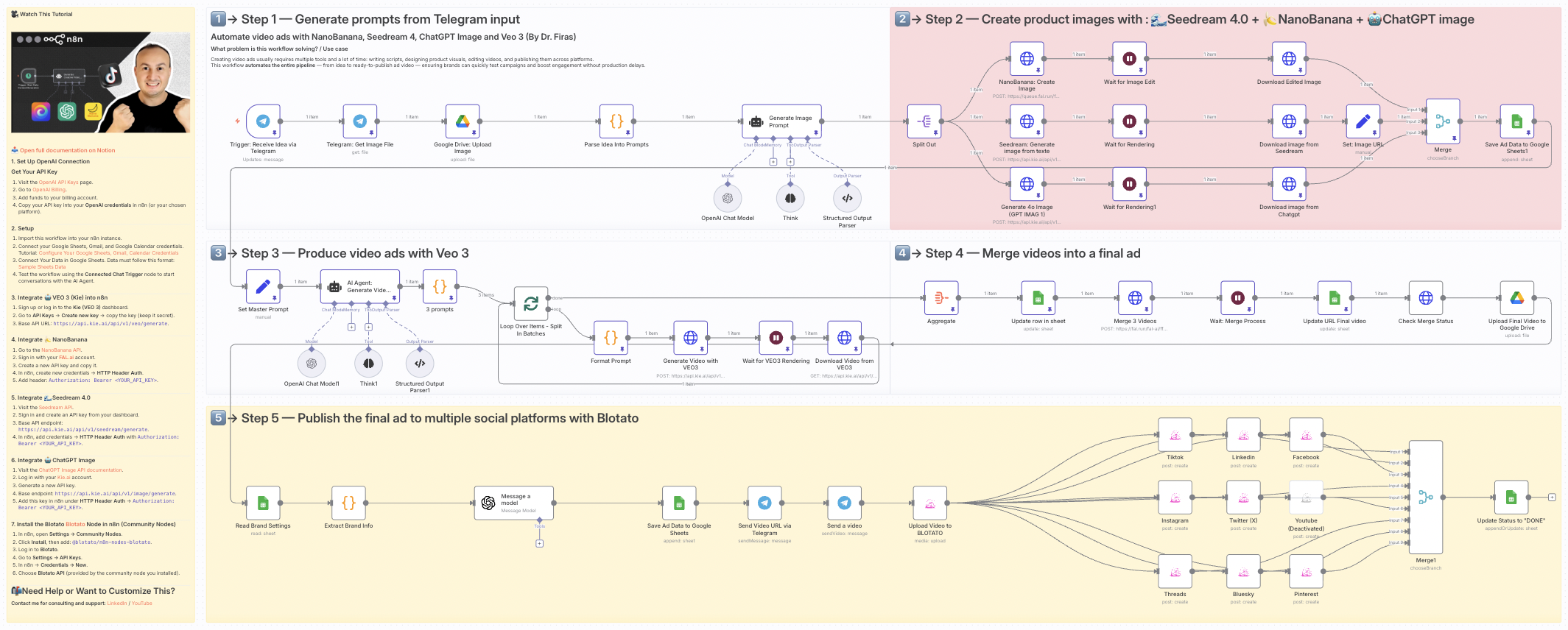
💥 Automate video ads with NanoBanana, Seedream 4, ChatGPT Image and Veo 3
Who is this for?
This template is designed for marketers, content creators, and e-commerce brands who want to automate the creation of professional ad videos at scale. It’s ideal for teams looking to generate consistent, high-quality video ads for social media without spending hours on manual design, editing, or publishing.
What problem is this workflow solving? / Use case
Creating video ads usually requires multiple tools and a lot of time: writing scripts, designing product visuals, editing videos, and publishing them across platforms.
This workflow automates the entire pipeline — from idea to ready-to-publish ad video — ensuring brands can quickly test campaigns and boost engagement without production delays.
What this workflow does
- Generates ad ideas from Telegram input (text + product image).
- Creates product visuals using multiple AI image engines:
- 🌊 Seedream 4.0 (realistic visuals)
- 🍌 NanoBanana (image editing & enhancement)
- 🤖 ChatGPT Image / GPT-4o (creative variations)
- Produces cinematic video ads with Veo 3 based on AI-generated scripts.
- Merges multiple short clips into a polished final ad.
- Publishes automatically to multiple platforms (TikTok, Instagram, LinkedIn, X, Threads, Facebook, Pinterest, Bluesky, YouTube) via Blotato.
- Stores metadata and results in Google Sheets & Google Drive for easy tracking.
- Notifies you via Telegram with the video link and copy.
Setup
- Connect your accounts in n8n:
- Telegram API (for input and notifications)
- Google Drive + Google Sheets (storage & tracking)
- Kie AI API (Seedream + Veo 3)
- Fal.ai API (NanoBanana + video merging)
- OpenAI (for script and prompt generation)
- Blotato API (for social publishing)
- Prepare a Google Sheet with brand info and settings (product name, category, features, offer, website URL).
- Deploy the workflow and connect your Telegram bot to start sending ad ideas (photo + caption).
- Run the workflow — it will automatically generate images, create videos, and publish to your chosen channels.
How to customize this workflow to your needs
- Brand customization: Adjust the Google Sheet values to reflect your brand’s offers and product features.
- Platforms: Enable/disable specific Blotato nodes depending on which platforms you want to publish to.
- Video style: Edit the AI agent’s system prompt to control tone, format, and transitions (cinematic, playful, modern, etc.).
- Notifications: Adapt Telegram nodes to send updates to different team members or channels.
- Storage: Change the Google Drive folder IDs to store generated videos and images in your preferred location.
This workflow lets you go from idea → images → cinematic ad video → auto-published content in minutes, fully automated.
📄 🎥 Watch This Tutorial: Step by Step
📄 Documentation: Notion Guide
Need help customizing?
Automate Video Ad Campaign Creation with AI (NanoBanana, Seedream, GPT-4o, Veo-3)
This n8n workflow automates the process of generating and publishing video ad campaigns by leveraging AI models (GPT-4o, Veo-3) and integrating with NanoBanana and Seedream platforms. It streamlines the entire campaign creation process, from initial data input to final ad generation and notification.
What it does
This workflow simplifies the creation of video ad campaigns through the following steps:
- Triggers on Telegram Message: The workflow starts when a specific command or message is received via Telegram.
- Initial Data Setup: It sets up initial data, likely including campaign parameters or prompts for the AI.
- Fetches Campaign Data: It retrieves campaign-related information from a Google Sheet, such as product details, target audience, or ad copy.
- Generates Ad Concepts with AI: An AI Agent (powered by LangChain, likely using GPT-4o) processes the input data to generate creative ad concepts and scripts.
- Parses AI Output: The AI's structured output (e.g., JSON) is parsed to extract key elements for the ad campaign.
- Creates Video Ad with NanoBanana/Seedream: It makes an HTTP request to a video generation platform (implied to be NanoBanana/Seedream) to create the video ad using the AI-generated concepts.
- Waits for Video Processing: The workflow pauses to allow time for the video generation platform to process and render the video.
- Retrieves Video Ad Details: After the wait, it fetches the details or URL of the newly created video ad from Google Drive.
- Updates Google Sheet: The workflow updates the Google Sheet with the generated video ad details, ensuring all campaign information is centralized.
- Notifies via Telegram: Finally, it sends a notification via Telegram with the details of the newly created video ad campaign.
Prerequisites/Requirements
To use this workflow, you will need:
- n8n Instance: A running n8n instance.
- Telegram Account & Bot: A Telegram bot and chat ID configured for triggering and notifications.
- Google Sheets Account: Access to a Google Sheet containing campaign data.
- Google Drive Account: For storing and retrieving generated video ads.
- OpenAI API Key: For the AI Agent (GPT-4o) to generate ad concepts.
- NanoBanana/Seedream Account: Access to the video generation platform (via HTTP Request node). This likely requires API keys or authentication for their services.
Setup/Usage
- Import the workflow: Download the JSON file and import it into your n8n instance.
- Configure Credentials:
- Set up your Telegram Bot API Token credential for both the "Telegram Trigger" and "Telegram" nodes.
- Configure your Google OAuth 2.0 credential for "Google Sheets" and "Google Drive" nodes.
- Set up your OpenAI API Key credential for the "OpenAI Chat Model" and "OpenAI" nodes.
- Configure any necessary HTTP Request credentials for the NanoBanana/Seedream API calls (e.g., API Key in headers or query parameters).
- Update Node Parameters:
- Telegram Trigger: Specify the command or message that should trigger the workflow.
- Google Sheets: Update the Spreadsheet ID and sheet names to match your campaign data.
- HTTP Request: Adjust the URL, headers, and body of the HTTP request to interact correctly with the NanoBanana/Seedream API, passing the AI-generated ad concepts.
- Google Drive: Specify the folder where generated videos should be stored or retrieved from.
- AI Agent / OpenAI Nodes: Review and adjust the prompts or model parameters as needed for optimal ad concept generation.
- Wait Node: Adjust the wait time if video processing takes longer or shorter.
- Activate the workflow: Once configured, activate the workflow to start automating your video ad campaigns.
Related Templates
Track competitor SEO keywords with Decodo + GPT-4.1-mini + Google Sheets
This workflow automates competitor keyword research using OpenAI LLM and Decodo for intelligent web scraping. Who this is for SEO specialists, content strategists, and growth marketers who want to automate keyword research and competitive intelligence. Marketing analysts managing multiple clients or websites who need consistent SEO tracking without manual data pulls. Agencies or automation engineers using Google Sheets as an SEO data dashboard for keyword monitoring and reporting. What problem this workflow solves Tracking competitor keywords manually is slow and inconsistent. Most SEO tools provide limited API access or lack contextual keyword analysis. This workflow solves that by: Automatically scraping any competitor’s webpage with Decodo. Using OpenAI GPT-4.1-mini to interpret keyword intent, density, and semantic focus. Storing structured keyword insights directly in Google Sheets for ongoing tracking and trend analysis. What this workflow does Trigger — Manually start the workflow or schedule it to run periodically. Input Setup — Define the website URL and target country (e.g., https://dev.to, france). Data Scraping (Decodo) — Fetch competitor web content and metadata. Keyword Analysis (OpenAI GPT-4.1-mini) Extract primary and secondary keywords. Identify focus topics and semantic entities. Generate a keyword density summary and SEO strength score. Recommend optimization and internal linking opportunities. Data Structuring — Clean and convert GPT output into JSON format. Data Storage (Google Sheets) — Append structured keyword data to a Google Sheet for long-term tracking. Setup Prerequisites If you are new to Decode, please signup on this link visit.decodo.com n8n account with workflow editor access Decodo API credentials OpenAI API key Google Sheets account connected via OAuth2 Make sure to install the Decodo Community node. Create a Google Sheet Add columns for: primarykeywords, seostrengthscore, keyworddensity_summary, etc. Share with your n8n Google account. Connect Credentials Add credentials for: Decodo API credentials - You need to register, login and obtain the Basic Authentication Token via Decodo Dashboard OpenAI API (for GPT-4o-mini) Google Sheets OAuth2 Configure Input Fields Edit the “Set Input Fields” node to set your target site and region. Run the Workflow Click Execute Workflow in n8n. View structured results in your connected Google Sheet. How to customize this workflow Track Multiple Competitors → Use a Google Sheet or CSV list of URLs; loop through them using the Split In Batches node. Add Language Detection → Add a Gemini or GPT node before keyword analysis to detect content language and adjust prompts. Enhance the SEO Report → Expand the GPT prompt to include backlink insights, metadata optimization, or readability checks. Integrate Visualization → Connect your Google Sheet to Looker Studio for SEO performance dashboards. Schedule Auto-Runs → Use the Cron Node to run weekly or monthly for competitor keyword refreshes. Summary This workflow automates competitor keyword research using: Decodo for intelligent web scraping OpenAI GPT-4.1-mini for keyword and SEO analysis Google Sheets for live tracking and reporting It’s a complete AI-powered SEO intelligence pipeline ideal for teams that want actionable insights on keyword gaps, optimization opportunities, and content focus trends, without relying on expensive SEO SaaS tools.
 By Ranjan Dailata
Generate song lyrics and music from text prompts using OpenAI and Fal.ai Minimax
Spark your creativity instantly in any chat—turn a simple prompt like "heartbreak ballad" into original, full-length lyrics and a professional AI-generated music track, all without leaving your conversation. 📋 What This Template Does This chat-triggered workflow harnesses AI to generate detailed, genre-matched song lyrics (at least 600 characters) from user messages, then queues them for music synthesis via Fal.ai's minimax-music model. It polls asynchronously until the track is ready, delivering lyrics and audio URL back in chat. Crafts original, structured lyrics with verses, choruses, and bridges using OpenAI Submits to Fal.ai for melody, instrumentation, and vocals aligned to the style Handles long-running generations with smart looping and status checks Returns complete song package (lyrics + audio link) for seamless sharing 🔧 Prerequisites n8n account (self-hosted or cloud with chat integration enabled) OpenAI account with API access for GPT models Fal.ai account for AI music generation 🔑 Required Credentials OpenAI API Setup Go to platform.openai.com → API keys (sidebar) Click "Create new secret key" → Name it (e.g., "n8n Songwriter") Copy the key and add to n8n as "OpenAI API" credential type Test by sending a simple chat completion request Fal.ai HTTP Header Auth Setup Sign up at fal.ai → Dashboard → API Keys Generate a new API key → Copy it In n8n, create "HTTP Header Auth" credential: Name="Fal.ai", Header Name="Authorization", Header Value="Key [Your API Key]" Test with a simple GET to their queue endpoint (e.g., /status) ⚙️ Configuration Steps Import the workflow JSON into your n8n instance Assign OpenAI API credentials to the "OpenAI Chat Model" node Assign Fal.ai HTTP Header Auth to the "Generate Music Track", "Check Generation Status", and "Fetch Final Result" nodes Activate the workflow—chat trigger will appear in your n8n chat interface Test by messaging: "Create an upbeat pop song about road trips" 🎯 Use Cases Content Creators: YouTubers generating custom jingles for videos on the fly, streamlining production from idea to audio export Educators: Music teachers using chat prompts to create era-specific folk tunes for classroom discussions, fostering interactive learning Gift Personalization: Friends crafting anniversary R&B tracks from shared memories via quick chats, delivering emotional audio surprises Artist Brainstorming: Songwriters prototyping hip-hop beats in real-time during sessions, accelerating collaboration and iteration ⚠️ Troubleshooting Invalid JSON from AI Agent: Ensure the system prompt stresses valid JSON; test the agent standalone with a sample query Music Generation Fails (401/403): Verify Fal.ai API key has minimax-music access; check usage quotas in dashboard Status Polling Loops Indefinitely: Bump wait time to 45-60s for complex tracks; inspect fal.ai queue logs for bottlenecks Lyrics Under 600 Characters: Tweak agent prompt to enforce fuller structures like [V1][C][V2][B][C]; verify output length in executions
 By Daniel Nkencho
Automate invoice processing with OCR, GPT-4 & Salesforce opportunity creation
PDF Invoice Extractor (AI) End-to-end pipeline: Watch Drive ➜ Download PDF ➜ OCR text ➜ AI normalize to JSON ➜ Upsert Buyer (Account) ➜ Create Opportunity ➜ Map Products ➜ Create OLI via Composite API ➜ Archive to OneDrive. --- Node by node (what it does & key setup) 1) Google Drive Trigger Purpose: Fire when a new file appears in a specific Google Drive folder. Key settings: Event: fileCreated Folder ID: google drive folder id Polling: everyMinute Creds: googleDriveOAuth2Api Output: Metadata { id, name, ... } for the new file. --- 2) Download File From Google Purpose: Get the file binary for processing and archiving. Key settings: Operation: download File ID: ={{ $json.id }} Creds: googleDriveOAuth2Api Output: Binary (default key: data) and original metadata. --- 3) Extract from File Purpose: Extract text from PDF (OCR as needed) for AI parsing. Key settings: Operation: pdf OCR: enable for scanned PDFs (in options) Output: JSON with OCR text at {{ $json.text }}. --- 4) Message a model (AI JSON Extractor) Purpose: Convert OCR text into strict normalized JSON array (invoice schema). Key settings: Node: @n8n/n8n-nodes-langchain.openAi Model: gpt-4.1 (or gpt-4.1-mini) Message role: system (the strict prompt; references {{ $json.text }}) jsonOutput: true Creds: openAiApi Output (per item): $.message.content → the parsed JSON (ensure it’s an array). --- 5) Create or update an account (Salesforce) Purpose: Upsert Buyer as Account using an external ID. Key settings: Resource: account Operation: upsert External Id Field: taxid_c External Id Value: ={{ $json.message.content.buyer.tax_id }} Name: ={{ $json.message.content.buyer.name }} Creds: salesforceOAuth2Api Output: Account record (captures Id) for downstream Opportunity. --- 6) Create an opportunity (Salesforce) Purpose: Create Opportunity linked to the Buyer (Account). Key settings: Resource: opportunity Name: ={{ $('Message a model').item.json.message.content.invoice.code }} Close Date: ={{ $('Message a model').item.json.message.content.invoice.issue_date }} Stage: Closed Won Amount: ={{ $('Message a model').item.json.message.content.summary.grand_total }} AccountId: ={{ $json.id }} (from Upsert Account output) Creds: salesforceOAuth2Api Output: Opportunity Id for OLI creation. --- 7) Build SOQL (Code / JS) Purpose: Collect unique product codes from AI JSON and build a SOQL query for PricebookEntry by Pricebook2Id. Key settings: pricebook2Id (hardcoded in script): e.g., 01sxxxxxxxxxxxxxxx Source lines: $('Message a model').first().json.message.content.products Output: { soql, codes } --- 8) Query PricebookEntries (Salesforce) Purpose: Fetch PricebookEntry.Id for each Product2.ProductCode. Key settings: Resource: search Query: ={{ $json.soql }} Creds: salesforceOAuth2Api Output: Items with Id, Product2.ProductCode (used for mapping). --- 9) Code in JavaScript (Build OLI payloads) Purpose: Join lines with PBE results and Opportunity Id ➜ build OpportunityLineItem payloads. Inputs: OpportunityId: ={{ $('Create an opportunity').first().json.id }} Lines: ={{ $('Message a model').first().json.message.content.products }} PBE rows: from previous node items Output: { body: { allOrNone:false, records:[{ OpportunityLineItem... }] } } Notes: Converts discount_total ➜ per-unit if needed (currently commented for standard pricing). Throws on missing PBE mapping or empty lines. --- 10) Create Opportunity Line Items (HTTP Request) Purpose: Bulk create OLIs via Salesforce Composite API. Key settings: Method: POST URL: https://<your-instance>.my.salesforce.com/services/data/v65.0/composite/sobjects Auth: salesforceOAuth2Api (predefined credential) Body (JSON): ={{ $json.body }} Output: Composite API results (per-record statuses). --- 11) Update File to One Drive Purpose: Archive the original PDF in OneDrive. Key settings: Operation: upload File Name: ={{ $json.name }} Parent Folder ID: onedrive folder id Binary Data: true (from the Download node) Creds: microsoftOneDriveOAuth2Api Output: Uploaded file metadata. --- Data flow (wiring) Google Drive Trigger → Download File From Google Download File From Google → Extract from File → Update File to One Drive Extract from File → Message a model Message a model → Create or update an account Create or update an account → Create an opportunity Create an opportunity → Build SOQL Build SOQL → Query PricebookEntries Query PricebookEntries → Code in JavaScript Code in JavaScript → Create Opportunity Line Items --- Quick setup checklist 🔐 Credentials: Connect Google Drive, OneDrive, Salesforce, OpenAI. 📂 IDs: Drive Folder ID (watch) OneDrive Parent Folder ID (archive) Salesforce Pricebook2Id (in the JS SOQL builder) 🧠 AI Prompt: Use the strict system prompt; jsonOutput = true. 🧾 Field mappings: Buyer tax id/name → Account upsert fields Invoice code/date/amount → Opportunity fields Product name must equal your Product2.ProductCode in SF. ✅ Test: Drop a sample PDF → verify: AI returns array JSON only Account/Opportunity created OLI records created PDF archived to OneDrive --- Notes & best practices If PDFs are scans, enable OCR in Extract from File. If AI returns non-JSON, keep “Return only a JSON array” as the last line of the prompt and keep jsonOutput enabled. Consider adding validation on parsing.warnings to gate Salesforce writes. For discounts/taxes in OLI: Standard OLI fields don’t support per-line discount amounts directly; model them in UnitPrice or custom fields. Replace the Composite API URL with your org’s domain or use the Salesforce node’s Bulk Upsert for simplicity.
 By Le Nguyen