AI news research team: 24/7 newsletter automation with citations with Perplexity

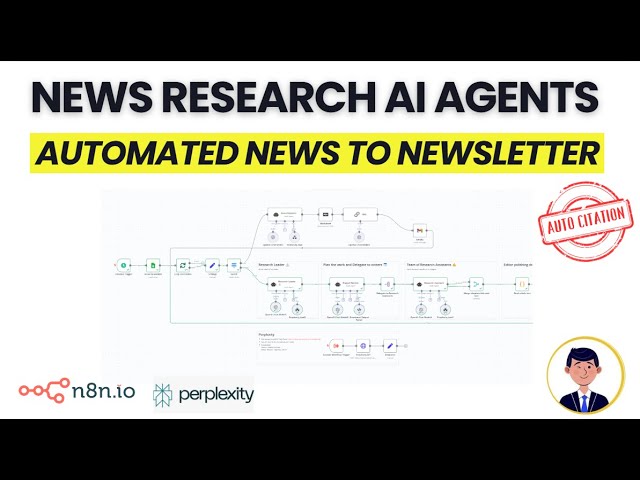
Purpose of workflow:
This AI-powered workflow automatically generates detailed, well-researched newsletters by monitoring and analyzing specified news topics (like Bitcoin, Nvidia, etc.). It uses a team of AI research agents to gather, analyze, and compile information with automatic citations, saving significant time in newsletter creation.
How it works:
Multi-agent system:
- Research Leader: Analyzes topics and creates content outline
- Project Planner: Breaks down research into specific tasks
- Research Assistants: Conduct detailed research on assigned subtopics
- Editor: Combines research and polishes final output
Key features:
- Automated daily monitoring of specified news topics
- Real-time information gathering using Perplexity AI
- Auto-citation functionality for source verification
- Flexible time window filtering (day/week/month)
- Options for detailed or simple reports
- Direct email delivery of completed newsletters
Step-by-step setup:
-
Perplexity API Setup:
- Create account at perplexity.ai
- Navigate to API tab
- Generate API key
- Set up credentials with 'Bearer' authentication
-
Workflow Configuration:
- Connect Google Sheets containing news monitoring topics
- Configure schedule trigger for daily execution
- Set up email delivery settings
- Define report type preferences (detailed/simple)
- Specify time window for news gathering
-
Integration:
- Connect with newsletter tools like Kit
- Import generated content as starting point
- Edit and customize as needed before publishing
AI News Research Team 24/7 Newsletter Automation with Citations (Perplexity)
This n8n workflow automates the process of generating a daily AI news newsletter, complete with research, summarization, and citations, leveraging AI agents and various tools. It's designed to simulate a 24/7 AI news research team, providing a streamlined way to stay updated and disseminate information.
What it does
This workflow orchestrates a sophisticated AI-driven news research and newsletter generation process:
- Triggers Daily: The workflow is scheduled to run daily, initiating the news research cycle.
- Initial AI Agent Call: It starts by calling an AI Agent (likely a "Manager" agent) to kick off the news research.
- AI Agent with Tools: The core of the workflow involves a powerful AI Agent that uses several tools:
- Perplexity Search Tool: Utilizes Perplexity AI for comprehensive web searches to gather the latest AI news.
- Call n8n Workflow Tool (Research Assistant): Delegates specific research tasks to a sub-workflow, acting as a "Research Assistant" to fetch and process news articles.
- Call n8n Workflow Tool (Summarizer): Delegates summarization tasks to another sub-workflow, acting as a "Summarizer" to condense information.
- Call n8n Workflow Tool (Citation Generator): Delegates citation generation to a sub-workflow, ensuring all sources are properly attributed.
- Structured Output Parsing: The output from the AI Agent is parsed into a structured format (e.g., JSON) to organize the gathered news, summaries, and citations.
- Loop and Process Articles: It iterates through each identified news article.
- Format Newsletter Content: For each article, it processes and formats the content into a markdown-friendly structure, including the summarized news and its corresponding citations.
- Consolidate Newsletter: All the individual article contents are merged into a single, comprehensive newsletter.
- Send Newsletter via Gmail: The final markdown-formatted newsletter is sent out via Gmail.
- Sub-Workflow: Research Assistant: This sub-workflow is called by the main AI Agent.
- Receives Input: Triggered by the main workflow, it receives a research query.
- Perplexity Search: Performs a web search using Perplexity AI based on the query.
- Extracts and Filters URLs: Identifies and extracts relevant URLs from the search results, filtering out any unwanted domains (e.g., YouTube).
- Fetches Article Content: For each valid URL, it makes an HTTP request to fetch the article's content.
- Returns Article Data: Returns the extracted article content and URL to the main workflow.
- Sub-Workflow: Summarizer: This sub-workflow is called by the main AI Agent.
- Receives Input: Triggered by the main workflow, it receives article text to summarize.
- Basic LLM Chain (Summarization): Uses a Large Language Model (LLM) (likely OpenAI Chat Model) with a specific prompt to summarize the provided text.
- Returns Summary: Returns the generated summary to the main workflow.
- Sub-Workflow: Citation Generator: This sub-workflow is called by the main AI Agent.
- Receives Input: Triggered by the main workflow, it receives article text and URL.
- Basic LLM Chain (Citation): Uses an LLM (likely OpenAI Chat Model) with a prompt to generate a citation based on the article content and URL.
- Returns Citation: Returns the generated citation to the main workflow.
Prerequisites/Requirements
- n8n Instance: A running n8n instance.
- OpenAI API Key: For the
OpenAI Chat Modelnodes used in summarization and citation generation. - Perplexity API Key: For the
Perplexity Search Toolused for web research. - Gmail Account: Configured as an n8n credential for sending the newsletter.
- Google Sheets Credential (Optional): Although a Google Sheets node is present, it's not actively connected in the provided JSON for the main flow. If intended for logging or other data storage, a Google Sheets credential would be needed.
Setup/Usage
- Import the Workflow: Import the provided JSON into your n8n instance.
- Configure Credentials:
- Set up your OpenAI API Key credential.
- Set up your Perplexity API Key credential.
- Configure your Gmail OAuth2 or API Key credential.
- (Optional) If using the Google Sheets node, configure your Google Sheets credential.
- Activate Sub-Workflows: Ensure the "Research Assistant", "Summarizer", and "Citation Generator" sub-workflows are also imported and activated, as the main workflow calls them using the
Execute Workflow Triggernode. You will need to note down their workflow IDs to configure theCall n8n Workflow Toolnodes. - Configure Nodes:
- Schedule Trigger (Node 839): Adjust the schedule as needed (e.g., daily at a specific time).
- AI Agent (Node 1119): Review the agent's prompt and tool configurations. Ensure the
Call n8n Workflow Toolnodes point to the correct workflow IDs for your "Research Assistant", "Summarizer", and "Citation Generator" sub-workflows. - Gmail (Node 356): Update the "To" email address for the newsletter recipients.
- Perplexity Search Tool (within AI Agent): Ensure the Perplexity credential is selected.
- OpenAI Chat Model (within Summarizer and Citation Generator sub-workflows): Ensure the OpenAI credential is selected.
- Enable the Workflow: Once configured, activate the main workflow and its sub-workflows.
Related Templates
AI multi-agent executive team for entrepreneurs with Gemini, Perplexity and WhatsApp
This workflow is an AI-powered multi-agent system built for startup founders and small business owners who want to automate decision-making, accountability, research, and communication, all through WhatsApp. The “virtual executive team,” is designed to help small teams to work smarter. This workflow sends you market analysis, market and sales tips, It can also monitor what your competitors are doing using perplexity (Research agent) and help you stay a head, or make better decisions. And when you feeling stuck with your start-up accountability director is creative enough to break the barrier 🎯 Core Features 🧑💼 1. President (Super Agent) Acts as the main controller that coordinates all sub-agents. Routes messages, assigns tasks, and ensures workflow synchronization between the AI Directors. 📊 2. Sales & Marketing Director Uses SerpAPI to search for market opportunities, leads, and trends. Suggests marketing campaigns, keywords, or outreach ideas. Can analyze current engagement metrics to adjust content strategy. 🕵️♀️ 3. Business Research Director Powered by Perplexity AI for competitive and market analysis. Monitors competitor moves, social media engagement, and product changes. Provides concise insights to help the founder adapt and stay ahead. ⏰ 4. Accountability Director Keeps the founder and executive team on track. Sends motivational nudges, task reminders, and progress reports. Promotes consistency and discipline — key traits for early-stage success. 🗓️ 5. Executive Secretary Handles scheduling, email drafting, and reminders. Connects with Google Calendar, Gmail, and Sheets through OAuth. Automates follow-ups, meeting summaries, and notifications directly via WhatsApp. 💬 WhatsApp as the Main Interface Interact naturally with your AI team through WhatsApp Business API. All responses, updates, and summaries are delivered to your chat. Ideal for founders who want to manage operations on the go. ⚙️ How It Works Trigger: The workflow starts from a WhatsApp Trigger node (via Meta Developer Account). Routing: The President agent analyzes the incoming message and determines which Director should handle it. Processing: Marketing or sales queries go to the Sales & Marketing Director. Research questions are handled by the Business Research Director. Accountability tasks are assigned to the Accountability Director. Scheduling or communication requests are managed by the Secretary. Collaboration: Each sub-agent returns results to the President, who summarizes and sends the reply back via WhatsApp. Memory: Context is maintained between sessions, ensuring personalized and coherent communication. 🧩 Integrations Required Gemini API – for general intelligence and task reasoning Supabase- for RAG and postgres persistent memory Perplexity API – for business and competitor analysis SerpAPI – for market research and opportunity scouting Google OAuth – to connect Sheets, Calendar, and Gmail WhatsApp Business API – for message triggers and responses 🚀 Benefits Acts like a team of tireless employees available 24/7. Saves time by automating research, reminders, and communication. Enhances accountability and strategy consistency for founders. Keeps operations centralized in a simple WhatsApp interface. 🧰 Setup Steps Create API credentials for: WhatsApp (via Meta Developer Account) Gemini, Perplexity, and SerpAPI Google OAuth (Sheets, Calendar, Gmail) Create a supabase account at supabase Add the credentials in the corresponding n8n nodes. Customize the system prompts for each Director based on your startup’s needs. Activate and start interacting with your virtual executive team on WhatsApp. Use Case You are a small organisation or start-up that can not afford hiring; marketing department, research department and secretar office, then this workflow is for you 💡 Need Customization? Want to tailor it for your startup or integrate with CRM tools like Notion or HubSpot? You can easily extend the workflow or contact the creator for personalized support. Consider adjusting the system prompt to suite your business
 By Shadrack
🎓 How to transform unstructured email data into structured format with AI agent
This workflow automates the process of extracting structured, usable information from unstructured email messages across multiple platforms. It connects directly to Gmail, Outlook, and IMAP accounts, retrieves incoming emails, and sends their content to an AI-powered parsing agent built on OpenAI GPT models. The AI agent analyzes each email, identifies relevant details, and returns a clean JSON structure containing key fields: From – sender’s email address To – recipient’s email address Subject – email subject line Summary – short AI-generated summary of the email body The extracted information is then automatically inserted into an n8n Data Table, creating a structured database of email metadata and summaries ready for indexing, reporting, or integration with other tools. --- Key Benefits ✅ Full Automation: Eliminates manual reading and data entry from incoming emails. ✅ Multi-Source Integration: Handles data from different email providers seamlessly. ✅ AI-Driven Accuracy: Uses advanced language models to interpret complex or unformatted content. ✅ Structured Storage: Creates a standardized, query-ready dataset from previously unstructured text. ✅ Time Efficiency: Processes emails in real time, improving productivity and response speed. *✅ Scalability: Easily extendable to handle additional sources or extract more data fields. --- How it works This workflow automates the transformation of unstructured email data into a structured, queryable format. It operates through a series of connected steps: Email Triggering: The workflow is initiated by one of three different email triggers (Gmail, Microsoft Outlook, or a generic IMAP account), which constantly monitor for new incoming emails. AI-Powered Parsing & Structuring: When a new email is detected, its raw, unstructured content is passed to a central "Parsing Agent." This agent uses a specified OpenAI language model to intelligently analyze the email text. Data Extraction & Standardization: Following a predefined system prompt, the AI agent extracts key information from the email, such as the sender, recipient, subject, and a generated summary. It then forces the output into a strict JSON structure using a "Structured Output Parser" node, ensuring data consistency. Data Storage: Finally, the clean, structured data (the from, to, subject, and summarize fields) is inserted as a new row into a specified n8n Data Table, creating a searchable and reportable database of email information. --- Set up steps To implement this workflow, follow these configuration steps: Prepare the Data Table: Create a new Data Table within n8n. Define the columns with the following names and string type: From, To, Subject, and Summary. Configure Email Credentials: Set up the credential connections for the email services you wish to use (Gmail OAuth2, Microsoft Outlook OAuth2, and/or IMAP). Ensure the accounts have the necessary permissions to read emails. Configure AI Model Credentials: Set up the OpenAI API credential with a valid API key. The workflow is configured to use the model, but this can be changed in the respective nodes if needed. Connect the Nodes: The workflow canvas is already correctly wired. Visually confirm that the email triggers are connected to the "Parsing Agent," which is connected to the "Insert row" (Data Table) node. Also, ensure the "OpenAI Chat Model" and "Structured Output Parser" are connected to the "Parsing Agent" as its AI model and output parser, respectively. Activate the Workflow: Save the workflow and toggle the "Active" switch to ON. The triggers will begin polling for new emails according to their schedule (e.g., every minute), and the automation will start processing incoming messages. --- Need help customizing? Contact me for consulting and support or add me on Linkedin.
 By Davide
Send WooCommerce discount coupons to customers via WhatsApp using Rapiwa API
Who is this for? This workflow is ideal for WooCommerce store owners who want to automatically send promotional WhatsApp messages to their customers when new coupons are created. It’s designed for marketers and eCommerce managers looking to boost engagement, streamline coupon sharing, and track campaign performance effortlessly through Google Sheets. Overview This workflow listens for WooCommerce coupon creation events (coupon.created) and uses customer billing data to send promotional WhatsApp messages via the Rapiwa API. The flow formats the coupon data, cleans phone numbers, verifies WhatsApp registration with Rapiwa, sends the promotional message when verified, and logs each attempt to Google Sheets (separate sheets for verified/sent and unverified/not sent). What this Workflow Does Listens for new coupon creation events in WooCommerce via the WooCommerce Trigger node Retrieves all customer data from the WooCommerce store Processes customers in batches to control throughput Cleans and formats customer phone numbers for WhatsApp Verifies if phone numbers are valid WhatsApp accounts using Rapiwa API Sends personalized WhatsApp messages with coupon details to verified numbers Logs all activities to Google Sheets for tracking and analysis Handles both verified and unverified numbers appropriately Key Features Automated coupon distribution: Triggers when new coupons are created in WooCommerce Customer data retrieval: Fetches all customer information from WooCommerce Phone number validation: Verifies WhatsApp numbers before sending messages Personalized messaging: Includes customer name and coupon details in messages Dual logging system: Tracks both successful and failed message attempts Rate limiting: Uses batching and wait nodes to prevent API overload Data formatting: Structures coupon information for consistent messaging Google Sheet Column Structure A Google Sheet formatted like this ➤ sample The workflow uses a Google Sheet with the following columns to track coupon distribution: | name | number | email | address1 | couponCode | couponTitle | couponType | couponAmount | createDate | expireDate | validity | status | | ----------- | ------------- | --------------------------------------------------- | --------- | ---------- | -------------- | ---------- | ------------ | ------------------- | ------------------- | ---------- | -------- | | Abdul Mannan | 8801322827799 | contact@spagreen.net | mirpur-DOHS | 62dhryst | eid offer 2025 | percent | 20.00 | 2025-09-11 06:08:02 | 2025-09-15 00:00:00 | unverified | not sent | | Abdul Mannan | 8801322827799 | contact@spagreen.net | mirpur-DOHS | 62dhryst | eid offer 2025 | percent | 20.00 | 2025-09-11 06:08:02 | 2025-09-15 00:00:00 | verified | sent | Requirements n8n instance with the following nodes: WooCommerce Trigger, Code, SplitInBatches, HTTP Request, IF, Google Sheets, Wait WooCommerce store with API access Rapiwa account with API access for WhatsApp verification and messaging Google account with Sheets access Customer phone numbers in WooCommerce (stored in billing.phone field) Important Notes Phone Number Format: The workflow cleans phone numbers by removing all non-digit characters. Ensure your WooCommerce phone numbers are in a compatible format. API Rate Limits: Rapiwa and WooCommerce APIs have rate limits. Adjust batch sizes and wait times accordingly. Data Privacy: Ensure compliance with data protection regulations when sending marketing messages. Error Handling: The workflow logs unverified numbers but doesn't have extensive error handling. Consider adding error notifications for failed API calls. Message Content: The current message template references the first coupon only (coupons[0]). Adjust if you need to handle multiple coupons. Useful Links Dashboard: https://app.rapiwa.com Official Website: https://rapiwa.com Documentation: https://docs.rapiwa.com Support & Help WhatsApp: Chat on WhatsApp Discord: SpaGreen Community Facebook Group: SpaGreen Support Website: https://spagreen.net Developer Portfolio: Codecanyon SpaGreen
 By Rapiwa