📦 AI-powered damage reporting tool for logistics with Gmail, Telegram and GPT

Tags: Logistics, Supply Chain, Warehouse Operations, Paperless processes, Quality Management
Context
Hi! I’m Samir — Supply Chain Engineer, Data Scientist based in Paris, and founder of LogiGreen.
> Let us use n8n to help small companies digitalise their logistics and supply chain!
This workflow helps warehouse operators generate a complete damage report without needing to write anything manually.
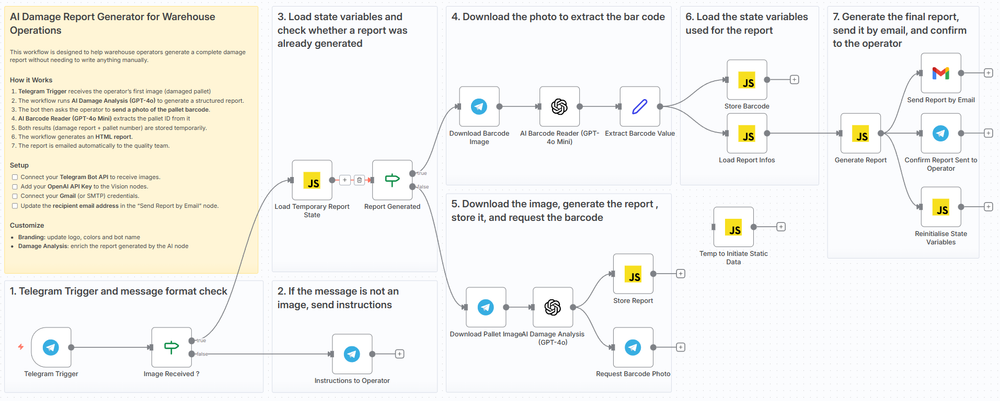
In warehouse operations, damaged pallets must be reported quickly and consistently.
You can automate the entire process using AI to analyse photos of the damages.
📬 For business inquiries, you can find me on LinkedIn
Example of damage report
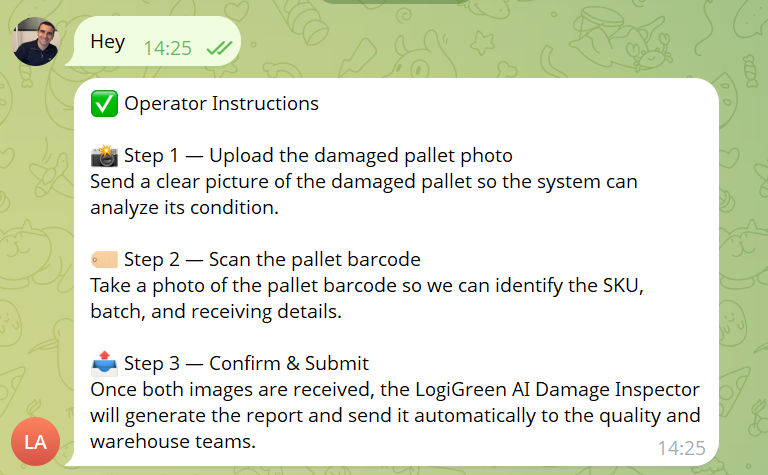
The process starts with instructions sent with the operator:
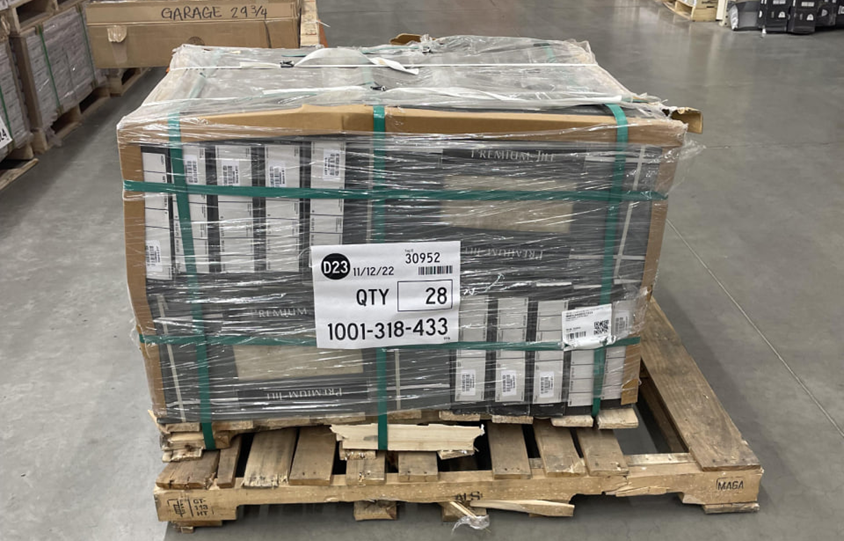
A photo of the damaged pallets is shared with the bot:
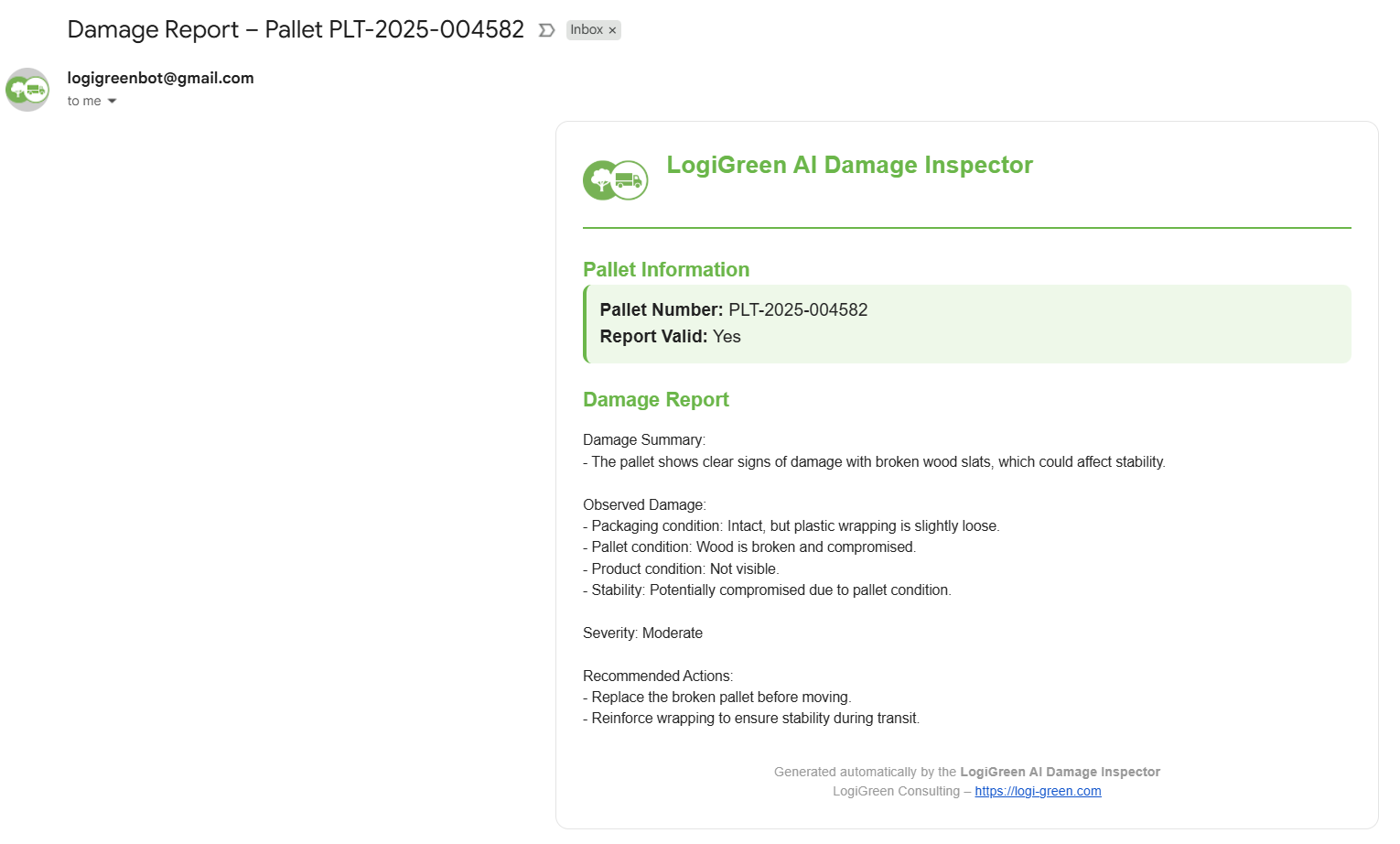
A complete report is generated and sent by email:
🎥 Tutorial
A complete tutorial (with explanations of every node) is available on YouTube:

Who is this template for?
This template is ideal for companies with limited IT ressources:
- Warehouse operators who need a fast reporting tool
- Quality teams who want consistent and structured reports
- 3PLs and logistics providers looking to digitalise damage claims
- Manufacturers and retailers with high inbound pallet volumes
- Anyone using Telegram on the warehouse floor for quick interactions
What does this workflow do?
This workflow acts as an AI-powered damaged goods reporting assistant using Telegram, OpenAI Vision and Gmail.
- A operator sends a picture of the damaged pallet via Telegram.
- The workflow downloads the image and sends it to GPT-4o for damage analysis.
- The bot replies and asks for a photo of the pallet barcode.
- The barcode picture is processed by GPT-4o Mini to extract the pallet number.
- The workflow combines both results (damage analysis + pallet ID).
- It generates an HTML email report with: damage summary, observed issues, severity level and recommended actions
- The report is automatically sent via Gmail to the configured recipient.
- The operator receives a confirmation message in Telegram.
The processes does not require any data input form the operator, only to take pictures!
Next Steps
Before running the workflow, follow the sticky notes and configure:
- Connect your Telegram Bot API
- Add your OpenAI API Key in the AI nodes
- Connect your Gmail credentials
- Update the recipient email in the “Send Report by Email” node
Submitted: 20 November 2025
Template designed with n8n version 1.116.2
AI-Powered Damage Reporting Tool for Logistics with Gmail, Telegram, and GPT
This n8n workflow automates the process of reporting damage in logistics, leveraging AI to analyze damage descriptions and communicate findings via Telegram and Gmail. It streamlines incident management by automatically classifying damage severity and generating detailed reports.
What it does
This workflow simplifies and automates the following steps:
- Receives Damage Reports: Listens for incoming damage reports, likely triggered by a Telegram message.
- Extracts and Processes Information: Prepares the received data for AI analysis.
- Analyzes Damage with AI: Utilizes OpenAI's capabilities to categorize the damage (e.g., "minor," "moderate," "severe") based on the provided description.
- Routes Based on Severity: Uses a conditional logic ("If" node) to direct the workflow based on the AI-determined damage severity.
- Notifies via Telegram: Sends a Telegram message with the damage report and its AI-classified severity.
- Sends Detailed Email (Conditional): If the damage is classified as "severe" (or a similar critical category), it dispatches a detailed email report via Gmail to relevant stakeholders.
Prerequisites/Requirements
To use this workflow, you will need:
- n8n Instance: A running n8n instance.
- Telegram Account & Bot: A Telegram account and a configured Telegram Bot for receiving triggers and sending notifications.
- OpenAI API Key: An API key for OpenAI to power the AI damage analysis.
- Gmail Account: A Gmail account configured as a credential in n8n for sending email reports.
Setup/Usage
- Import the Workflow:
- Download the provided JSON file.
- In your n8n instance, go to "Workflows" and click "New".
- Click the "Import from JSON" button and paste the workflow JSON or upload the file.
- Configure Credentials:
- Telegram Trigger: Configure your Telegram Bot credential. Ensure the bot is set up to receive messages and the webhook is correctly configured in n8n.
- Telegram Node: Configure your Telegram Bot credential for sending messages.
- OpenAI Node: Add your OpenAI API Key as a credential.
- Gmail Node: Set up your Gmail OAuth2 or API key credential.
- Customize Nodes (Optional):
- Code Node: Review and adjust the JavaScript code if you need to modify how the input data is prepared for OpenAI or how the output is structured.
- OpenAI Node: Fine-tune the OpenAI prompt and model parameters to best suit your damage classification needs.
- If Node: Adjust the conditions in the "If" node to define what constitutes "severe" damage or any other routing logic you require.
- Telegram Node: Customize the message content sent to Telegram.
- Gmail Node: Customize the recipient, subject, and body of the email for severe damage reports.
- Activate the Workflow: Once all credentials and configurations are set, activate the workflow.
The workflow will now listen for messages sent to your Telegram bot. When a message is received, it will process the damage description, classify its severity using AI, and send appropriate notifications.
Related Templates
AI multi-agent executive team for entrepreneurs with Gemini, Perplexity and WhatsApp
This workflow is an AI-powered multi-agent system built for startup founders and small business owners who want to automate decision-making, accountability, research, and communication, all through WhatsApp. The “virtual executive team,” is designed to help small teams to work smarter. This workflow sends you market analysis, market and sales tips, It can also monitor what your competitors are doing using perplexity (Research agent) and help you stay a head, or make better decisions. And when you feeling stuck with your start-up accountability director is creative enough to break the barrier 🎯 Core Features 🧑💼 1. President (Super Agent) Acts as the main controller that coordinates all sub-agents. Routes messages, assigns tasks, and ensures workflow synchronization between the AI Directors. 📊 2. Sales & Marketing Director Uses SerpAPI to search for market opportunities, leads, and trends. Suggests marketing campaigns, keywords, or outreach ideas. Can analyze current engagement metrics to adjust content strategy. 🕵️♀️ 3. Business Research Director Powered by Perplexity AI for competitive and market analysis. Monitors competitor moves, social media engagement, and product changes. Provides concise insights to help the founder adapt and stay ahead. ⏰ 4. Accountability Director Keeps the founder and executive team on track. Sends motivational nudges, task reminders, and progress reports. Promotes consistency and discipline — key traits for early-stage success. 🗓️ 5. Executive Secretary Handles scheduling, email drafting, and reminders. Connects with Google Calendar, Gmail, and Sheets through OAuth. Automates follow-ups, meeting summaries, and notifications directly via WhatsApp. 💬 WhatsApp as the Main Interface Interact naturally with your AI team through WhatsApp Business API. All responses, updates, and summaries are delivered to your chat. Ideal for founders who want to manage operations on the go. ⚙️ How It Works Trigger: The workflow starts from a WhatsApp Trigger node (via Meta Developer Account). Routing: The President agent analyzes the incoming message and determines which Director should handle it. Processing: Marketing or sales queries go to the Sales & Marketing Director. Research questions are handled by the Business Research Director. Accountability tasks are assigned to the Accountability Director. Scheduling or communication requests are managed by the Secretary. Collaboration: Each sub-agent returns results to the President, who summarizes and sends the reply back via WhatsApp. Memory: Context is maintained between sessions, ensuring personalized and coherent communication. 🧩 Integrations Required Gemini API – for general intelligence and task reasoning Supabase- for RAG and postgres persistent memory Perplexity API – for business and competitor analysis SerpAPI – for market research and opportunity scouting Google OAuth – to connect Sheets, Calendar, and Gmail WhatsApp Business API – for message triggers and responses 🚀 Benefits Acts like a team of tireless employees available 24/7. Saves time by automating research, reminders, and communication. Enhances accountability and strategy consistency for founders. Keeps operations centralized in a simple WhatsApp interface. 🧰 Setup Steps Create API credentials for: WhatsApp (via Meta Developer Account) Gemini, Perplexity, and SerpAPI Google OAuth (Sheets, Calendar, Gmail) Create a supabase account at supabase Add the credentials in the corresponding n8n nodes. Customize the system prompts for each Director based on your startup’s needs. Activate and start interacting with your virtual executive team on WhatsApp. Use Case You are a small organisation or start-up that can not afford hiring; marketing department, research department and secretar office, then this workflow is for you 💡 Need Customization? Want to tailor it for your startup or integrate with CRM tools like Notion or HubSpot? You can easily extend the workflow or contact the creator for personalized support. Consider adjusting the system prompt to suite your business
 By Shadrack
🎓 How to transform unstructured email data into structured format with AI agent
This workflow automates the process of extracting structured, usable information from unstructured email messages across multiple platforms. It connects directly to Gmail, Outlook, and IMAP accounts, retrieves incoming emails, and sends their content to an AI-powered parsing agent built on OpenAI GPT models. The AI agent analyzes each email, identifies relevant details, and returns a clean JSON structure containing key fields: From – sender’s email address To – recipient’s email address Subject – email subject line Summary – short AI-generated summary of the email body The extracted information is then automatically inserted into an n8n Data Table, creating a structured database of email metadata and summaries ready for indexing, reporting, or integration with other tools. --- Key Benefits ✅ Full Automation: Eliminates manual reading and data entry from incoming emails. ✅ Multi-Source Integration: Handles data from different email providers seamlessly. ✅ AI-Driven Accuracy: Uses advanced language models to interpret complex or unformatted content. ✅ Structured Storage: Creates a standardized, query-ready dataset from previously unstructured text. ✅ Time Efficiency: Processes emails in real time, improving productivity and response speed. *✅ Scalability: Easily extendable to handle additional sources or extract more data fields. --- How it works This workflow automates the transformation of unstructured email data into a structured, queryable format. It operates through a series of connected steps: Email Triggering: The workflow is initiated by one of three different email triggers (Gmail, Microsoft Outlook, or a generic IMAP account), which constantly monitor for new incoming emails. AI-Powered Parsing & Structuring: When a new email is detected, its raw, unstructured content is passed to a central "Parsing Agent." This agent uses a specified OpenAI language model to intelligently analyze the email text. Data Extraction & Standardization: Following a predefined system prompt, the AI agent extracts key information from the email, such as the sender, recipient, subject, and a generated summary. It then forces the output into a strict JSON structure using a "Structured Output Parser" node, ensuring data consistency. Data Storage: Finally, the clean, structured data (the from, to, subject, and summarize fields) is inserted as a new row into a specified n8n Data Table, creating a searchable and reportable database of email information. --- Set up steps To implement this workflow, follow these configuration steps: Prepare the Data Table: Create a new Data Table within n8n. Define the columns with the following names and string type: From, To, Subject, and Summary. Configure Email Credentials: Set up the credential connections for the email services you wish to use (Gmail OAuth2, Microsoft Outlook OAuth2, and/or IMAP). Ensure the accounts have the necessary permissions to read emails. Configure AI Model Credentials: Set up the OpenAI API credential with a valid API key. The workflow is configured to use the model, but this can be changed in the respective nodes if needed. Connect the Nodes: The workflow canvas is already correctly wired. Visually confirm that the email triggers are connected to the "Parsing Agent," which is connected to the "Insert row" (Data Table) node. Also, ensure the "OpenAI Chat Model" and "Structured Output Parser" are connected to the "Parsing Agent" as its AI model and output parser, respectively. Activate the Workflow: Save the workflow and toggle the "Active" switch to ON. The triggers will begin polling for new emails according to their schedule (e.g., every minute), and the automation will start processing incoming messages. --- Need help customizing? Contact me for consulting and support or add me on Linkedin.
 By Davide
Send WooCommerce discount coupons to customers via WhatsApp using Rapiwa API
Who is this for? This workflow is ideal for WooCommerce store owners who want to automatically send promotional WhatsApp messages to their customers when new coupons are created. It’s designed for marketers and eCommerce managers looking to boost engagement, streamline coupon sharing, and track campaign performance effortlessly through Google Sheets. Overview This workflow listens for WooCommerce coupon creation events (coupon.created) and uses customer billing data to send promotional WhatsApp messages via the Rapiwa API. The flow formats the coupon data, cleans phone numbers, verifies WhatsApp registration with Rapiwa, sends the promotional message when verified, and logs each attempt to Google Sheets (separate sheets for verified/sent and unverified/not sent). What this Workflow Does Listens for new coupon creation events in WooCommerce via the WooCommerce Trigger node Retrieves all customer data from the WooCommerce store Processes customers in batches to control throughput Cleans and formats customer phone numbers for WhatsApp Verifies if phone numbers are valid WhatsApp accounts using Rapiwa API Sends personalized WhatsApp messages with coupon details to verified numbers Logs all activities to Google Sheets for tracking and analysis Handles both verified and unverified numbers appropriately Key Features Automated coupon distribution: Triggers when new coupons are created in WooCommerce Customer data retrieval: Fetches all customer information from WooCommerce Phone number validation: Verifies WhatsApp numbers before sending messages Personalized messaging: Includes customer name and coupon details in messages Dual logging system: Tracks both successful and failed message attempts Rate limiting: Uses batching and wait nodes to prevent API overload Data formatting: Structures coupon information for consistent messaging Google Sheet Column Structure A Google Sheet formatted like this ➤ sample The workflow uses a Google Sheet with the following columns to track coupon distribution: | name | number | email | address1 | couponCode | couponTitle | couponType | couponAmount | createDate | expireDate | validity | status | | ----------- | ------------- | --------------------------------------------------- | --------- | ---------- | -------------- | ---------- | ------------ | ------------------- | ------------------- | ---------- | -------- | | Abdul Mannan | 8801322827799 | contact@spagreen.net | mirpur-DOHS | 62dhryst | eid offer 2025 | percent | 20.00 | 2025-09-11 06:08:02 | 2025-09-15 00:00:00 | unverified | not sent | | Abdul Mannan | 8801322827799 | contact@spagreen.net | mirpur-DOHS | 62dhryst | eid offer 2025 | percent | 20.00 | 2025-09-11 06:08:02 | 2025-09-15 00:00:00 | verified | sent | Requirements n8n instance with the following nodes: WooCommerce Trigger, Code, SplitInBatches, HTTP Request, IF, Google Sheets, Wait WooCommerce store with API access Rapiwa account with API access for WhatsApp verification and messaging Google account with Sheets access Customer phone numbers in WooCommerce (stored in billing.phone field) Important Notes Phone Number Format: The workflow cleans phone numbers by removing all non-digit characters. Ensure your WooCommerce phone numbers are in a compatible format. API Rate Limits: Rapiwa and WooCommerce APIs have rate limits. Adjust batch sizes and wait times accordingly. Data Privacy: Ensure compliance with data protection regulations when sending marketing messages. Error Handling: The workflow logs unverified numbers but doesn't have extensive error handling. Consider adding error notifications for failed API calls. Message Content: The current message template references the first coupon only (coupons[0]). Adjust if you need to handle multiple coupons. Useful Links Dashboard: https://app.rapiwa.com Official Website: https://rapiwa.com Documentation: https://docs.rapiwa.com Support & Help WhatsApp: Chat on WhatsApp Discord: SpaGreen Community Facebook Group: SpaGreen Support Website: https://spagreen.net Developer Portfolio: Codecanyon SpaGreen
 By Rapiwa