🚚 Estimate driving time and distance for logistics with Open Route API

Tags: Supply Chain, Logistics, Route Planning, Transportation, GPS API
Context
Hi! I’m Samir, a Supply Chain Engineer and Data Scientist based in Paris, and founder of LogiGreen Consulting.
I help companies improve their logistics operations using data, AI, and automation to reduce costs and minimize environmental footprint.
> Let’s use n8n to build smarter and greener transport operations!
📬 For business inquiries, you can add find me on LinkedIn
Who is this template for?
This workflow is designed for logistics and transport teams who want to automate distance and travel time calculations for truck shipments.
Ideal for:
- Control tower dashboards
- Transport cost simulations
- Route optimisation studies
How does it work?
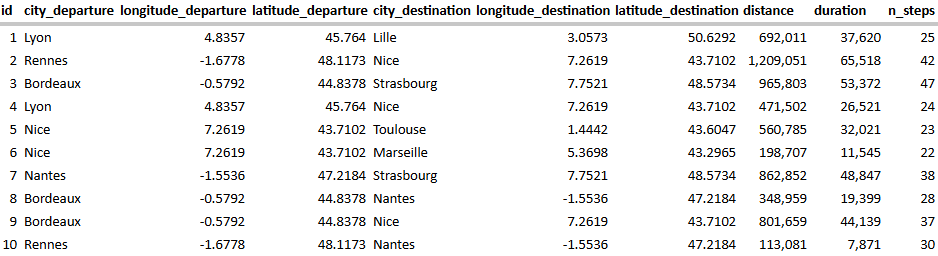
This n8n workflow connects to a Google Sheet where you store city-to-city shipment lanes, and uses the OpenRouteService API to calculate:
- 📏 Distance (in meters)
- ⏱️ Travel time (in seconds)
- 🪪 Number of route steps
Steps:
- ✅ Load departure/destination city coordinates from a Google Sheet
- 🔁 Loop through each record
- 🚚 Query OpenRouteService using the truck (driving-hgv) profile
- 🧾 Extract and store results: distance, duration, number of steps
- 📤 Update the Google Sheet with new values
What do I need to get started?
This workflow is beginner-friendly and requires:
- A Google Sheet with route pairs (departure and destination coordinates)
- A free OpenRouteService API key
👉 Get one here
Next Steps
🗒️ Follow the sticky notes inside the workflow to:
- Select your sheet
- Plug in your API key
- Launch the flow!
🚀 You can customize the workflow to:
- Add CO2 emission estimates for Sustainability Reporting
- Connect to your TMS via API or EDI
This template was built using n8n v1.93.0
Submitted: June 1, 2025
Estimate Driving Time and Distance for Logistics with OpenRouteService API
This n8n workflow helps logistics operations by calculating driving time and distance between multiple locations using the OpenRouteService API. It processes a list of addresses from a Google Sheet, enriches them with geographical coordinates, and then calculates the route details.
What it does
- Triggers Manually: The workflow starts when manually executed.
- Reads Data from Google Sheets: It fetches a list of addresses from a specified Google Sheet.
- Prepares Data for Geocoding: It transforms the address data into a format suitable for the OpenRouteService Geocoding API.
- Geocodes Addresses: For each address, it calls the OpenRouteService Geocoding API to convert the address into latitude and longitude coordinates.
- Adds Geocoded Data: It combines the original address data with the newly obtained geographical coordinates.
- Loops Over Items: It processes the geocoded addresses in batches to handle API rate limits or large datasets efficiently.
- Waits (Optional Delay): A
Waitnode is included, which can be configured to introduce a delay between API calls to prevent hitting rate limits. - Calculates Route: For each pair of locations (origin and destination), it calls the OpenRouteService Directions API to calculate the driving time and distance.
- Processes Route Results: It extracts relevant driving time and distance information from the API response.
- Updates Google Sheet (Implicit): Although not explicitly connected in the provided JSON, a typical next step would be to write the calculated driving times and distances back to the Google Sheet or another data store.
Prerequisites/Requirements
- n8n Instance: A running n8n instance.
- Google Sheets Account: Access to a Google Sheet containing the addresses.
- OpenRouteService API Key: An API key for the OpenRouteService platform (available at https://openrouteservice.org/). This will be used for both geocoding and directions.
Setup/Usage
- Import the Workflow: Import the provided JSON into your n8n instance.
- Configure Google Sheets Node:
- Set up your Google Sheets credential.
- Specify the Spreadsheet ID and Sheet Name where your addresses are located.
- Configure HTTP Request Nodes (OpenRouteService):
- Geocoding HTTP Request:
- Set the URL for the OpenRouteService Geocoding API (e.g.,
https://api.openrouteservice.org/geocode/search). - Add your OpenRouteService API key as a header (e.g.,
Authorization: Bearer YOUR_ORS_API_KEY). - Configure the body to send the address for geocoding.
- Set the URL for the OpenRouteService Geocoding API (e.g.,
- Directions HTTP Request:
- Set the URL for the OpenRouteService Directions API (e.g.,
https://api.openrouteservice.org/v2/directions/driving-car). - Add your OpenRouteService API key as a header.
- Configure the body to send the origin and destination coordinates for route calculation.
- Set the URL for the OpenRouteService Directions API (e.g.,
- Geocoding HTTP Request:
- Adjust 'Edit Fields' Node: Ensure the 'Edit Fields' node correctly maps your incoming address fields to the expected input for the OpenRouteService API calls.
- Adjust 'Loop Over Items' Node: If you have a very large number of addresses, you might want to adjust the batch size to manage API limits.
- Configure 'Wait' Node: If you encounter API rate limit issues, increase the delay in the
Waitnode. - Add Output Node (Optional but Recommended): Connect the final output of the route calculation to a Google Sheets node (or another database/service) to write back the calculated driving times and distances.
- Execute the Workflow: Click the "Execute workflow" button to run the process.
Related Templates
Track competitor SEO keywords with Decodo + GPT-4.1-mini + Google Sheets
This workflow automates competitor keyword research using OpenAI LLM and Decodo for intelligent web scraping. Who this is for SEO specialists, content strategists, and growth marketers who want to automate keyword research and competitive intelligence. Marketing analysts managing multiple clients or websites who need consistent SEO tracking without manual data pulls. Agencies or automation engineers using Google Sheets as an SEO data dashboard for keyword monitoring and reporting. What problem this workflow solves Tracking competitor keywords manually is slow and inconsistent. Most SEO tools provide limited API access or lack contextual keyword analysis. This workflow solves that by: Automatically scraping any competitor’s webpage with Decodo. Using OpenAI GPT-4.1-mini to interpret keyword intent, density, and semantic focus. Storing structured keyword insights directly in Google Sheets for ongoing tracking and trend analysis. What this workflow does Trigger — Manually start the workflow or schedule it to run periodically. Input Setup — Define the website URL and target country (e.g., https://dev.to, france). Data Scraping (Decodo) — Fetch competitor web content and metadata. Keyword Analysis (OpenAI GPT-4.1-mini) Extract primary and secondary keywords. Identify focus topics and semantic entities. Generate a keyword density summary and SEO strength score. Recommend optimization and internal linking opportunities. Data Structuring — Clean and convert GPT output into JSON format. Data Storage (Google Sheets) — Append structured keyword data to a Google Sheet for long-term tracking. Setup Prerequisites If you are new to Decode, please signup on this link visit.decodo.com n8n account with workflow editor access Decodo API credentials OpenAI API key Google Sheets account connected via OAuth2 Make sure to install the Decodo Community node. Create a Google Sheet Add columns for: primarykeywords, seostrengthscore, keyworddensity_summary, etc. Share with your n8n Google account. Connect Credentials Add credentials for: Decodo API credentials - You need to register, login and obtain the Basic Authentication Token via Decodo Dashboard OpenAI API (for GPT-4o-mini) Google Sheets OAuth2 Configure Input Fields Edit the “Set Input Fields” node to set your target site and region. Run the Workflow Click Execute Workflow in n8n. View structured results in your connected Google Sheet. How to customize this workflow Track Multiple Competitors → Use a Google Sheet or CSV list of URLs; loop through them using the Split In Batches node. Add Language Detection → Add a Gemini or GPT node before keyword analysis to detect content language and adjust prompts. Enhance the SEO Report → Expand the GPT prompt to include backlink insights, metadata optimization, or readability checks. Integrate Visualization → Connect your Google Sheet to Looker Studio for SEO performance dashboards. Schedule Auto-Runs → Use the Cron Node to run weekly or monthly for competitor keyword refreshes. Summary This workflow automates competitor keyword research using: Decodo for intelligent web scraping OpenAI GPT-4.1-mini for keyword and SEO analysis Google Sheets for live tracking and reporting It’s a complete AI-powered SEO intelligence pipeline ideal for teams that want actionable insights on keyword gaps, optimization opportunities, and content focus trends, without relying on expensive SEO SaaS tools.
 By Ranjan Dailata
Generate song lyrics and music from text prompts using OpenAI and Fal.ai Minimax
Spark your creativity instantly in any chat—turn a simple prompt like "heartbreak ballad" into original, full-length lyrics and a professional AI-generated music track, all without leaving your conversation. 📋 What This Template Does This chat-triggered workflow harnesses AI to generate detailed, genre-matched song lyrics (at least 600 characters) from user messages, then queues them for music synthesis via Fal.ai's minimax-music model. It polls asynchronously until the track is ready, delivering lyrics and audio URL back in chat. Crafts original, structured lyrics with verses, choruses, and bridges using OpenAI Submits to Fal.ai for melody, instrumentation, and vocals aligned to the style Handles long-running generations with smart looping and status checks Returns complete song package (lyrics + audio link) for seamless sharing 🔧 Prerequisites n8n account (self-hosted or cloud with chat integration enabled) OpenAI account with API access for GPT models Fal.ai account for AI music generation 🔑 Required Credentials OpenAI API Setup Go to platform.openai.com → API keys (sidebar) Click "Create new secret key" → Name it (e.g., "n8n Songwriter") Copy the key and add to n8n as "OpenAI API" credential type Test by sending a simple chat completion request Fal.ai HTTP Header Auth Setup Sign up at fal.ai → Dashboard → API Keys Generate a new API key → Copy it In n8n, create "HTTP Header Auth" credential: Name="Fal.ai", Header Name="Authorization", Header Value="Key [Your API Key]" Test with a simple GET to their queue endpoint (e.g., /status) ⚙️ Configuration Steps Import the workflow JSON into your n8n instance Assign OpenAI API credentials to the "OpenAI Chat Model" node Assign Fal.ai HTTP Header Auth to the "Generate Music Track", "Check Generation Status", and "Fetch Final Result" nodes Activate the workflow—chat trigger will appear in your n8n chat interface Test by messaging: "Create an upbeat pop song about road trips" 🎯 Use Cases Content Creators: YouTubers generating custom jingles for videos on the fly, streamlining production from idea to audio export Educators: Music teachers using chat prompts to create era-specific folk tunes for classroom discussions, fostering interactive learning Gift Personalization: Friends crafting anniversary R&B tracks from shared memories via quick chats, delivering emotional audio surprises Artist Brainstorming: Songwriters prototyping hip-hop beats in real-time during sessions, accelerating collaboration and iteration ⚠️ Troubleshooting Invalid JSON from AI Agent: Ensure the system prompt stresses valid JSON; test the agent standalone with a sample query Music Generation Fails (401/403): Verify Fal.ai API key has minimax-music access; check usage quotas in dashboard Status Polling Loops Indefinitely: Bump wait time to 45-60s for complex tracks; inspect fal.ai queue logs for bottlenecks Lyrics Under 600 Characters: Tweak agent prompt to enforce fuller structures like [V1][C][V2][B][C]; verify output length in executions
 By Daniel Nkencho
Automate Dutch Public Procurement Data Collection with TenderNed
TenderNed Public Procurement What This Workflow Does This workflow automates the collection of public procurement data from TenderNed (the official Dutch tender platform). It: Fetches the latest tender publications from the TenderNed API Retrieves detailed information in both XML and JSON formats for each tender Parses and extracts key information like organization names, titles, descriptions, and reference numbers Filters results based on your custom criteria Stores the data in a database for easy querying and analysis Setup Instructions This template comes with sticky notes providing step-by-step instructions in Dutch and various query options you can customize. Prerequisites TenderNed API Access - Register at TenderNed for API credentials Configuration Steps Set up TenderNed credentials: Add HTTP Basic Auth credentials with your TenderNed API username and password Apply these credentials to the three HTTP Request nodes: "Tenderned Publicaties" "Haal XML Details" "Haal JSON Details" Customize filters: Modify the "Filter op ..." node to match your specific requirements Examples: specific organizations, contract values, regions, etc. How It Works Step 1: Trigger The workflow can be triggered either manually for testing or automatically on a daily schedule. Step 2: Fetch Publications Makes an API call to TenderNed to retrieve a list of recent publications (up to 100 per request). Step 3: Process & Split Extracts the tender array from the response and splits it into individual items for processing. Step 4: Fetch Details For each tender, the workflow makes two parallel API calls: XML endpoint - Retrieves the complete tender documentation in XML format JSON endpoint - Fetches metadata including reference numbers and keywords Step 5: Parse & Merge Parses the XML data and merges it with the JSON metadata and batch information into a single data structure. Step 6: Extract Fields Maps the raw API data to clean, structured fields including: Publication ID and date Organization name Tender title and description Reference numbers (kenmerk, TED number) Step 7: Filter Applies your custom filter criteria to focus on relevant tenders only. Step 8: Store Inserts the processed data into your database for storage and future analysis. Customization Tips Modify API Parameters In the "Tenderned Publicaties" node, you can adjust: offset: Starting position for pagination size: Number of results per request (max 100) Add query parameters for date ranges, status filters, etc. Add More Fields Extend the "Splits Alle Velden" node to extract additional fields from the XML/JSON data, such as: Contract value estimates Deadline dates CPV codes (procurement classification) Contact information Integrate Notifications Add a Slack, Email, or Discord node after the filter to get notified about new matching tenders. Incremental Updates Modify the workflow to only fetch new tenders by: Storing the last execution timestamp Adding date filters to the API query Only processing publications newer than the last run Troubleshooting No data returned? Verify your TenderNed API credentials are correct Check that you have setup youre filter proper Need help setting this up or interested in a complete tender analysis solution? Get in touch 🔗 LinkedIn – Wessel Bulte
 By Wessel Bulte