🧑🦯Improve your website accessibility with GPT-4o and Google Sheet

Tags: Accessibility, SEO, Blogging, Marketing, Automation, AI, Web Auditing
Context
Hey! I’m Samir, a Supply Chain Engineer and Data Scientist from Paris, and the founder of LogiGreen Consulting.
In my personal blog, I share insights on how to use AI, automation, and data analytics to improve logistics, operations, and digital sustainability practices.

> Have you heard about accessibility?
In this workflow, I use n8n to improve the quality of alternative texts for images on my personal website.
📬 For business inquiries, you can connect with me on LinkedIn
Who is this template for?
This workflow is for:
- Bloggers and website owners who want to improve accessibility
- SEO professionals looking to boost page performance
- Web developers and product teams automating web audits
What does it do?
This n8n workflow:
- 🔍 Downloads the HTML of a blog or web page
- 🖼️ Extracts all
<img>tags and theiraltattributes - 📉 Detects missing or too-short alt texts
- 🤖 Sends those images to GPT-4o (with vision) to generate new alt descriptions
- 📄 Saves the results into a Google Sheet, updating the alt text when needed
How it works
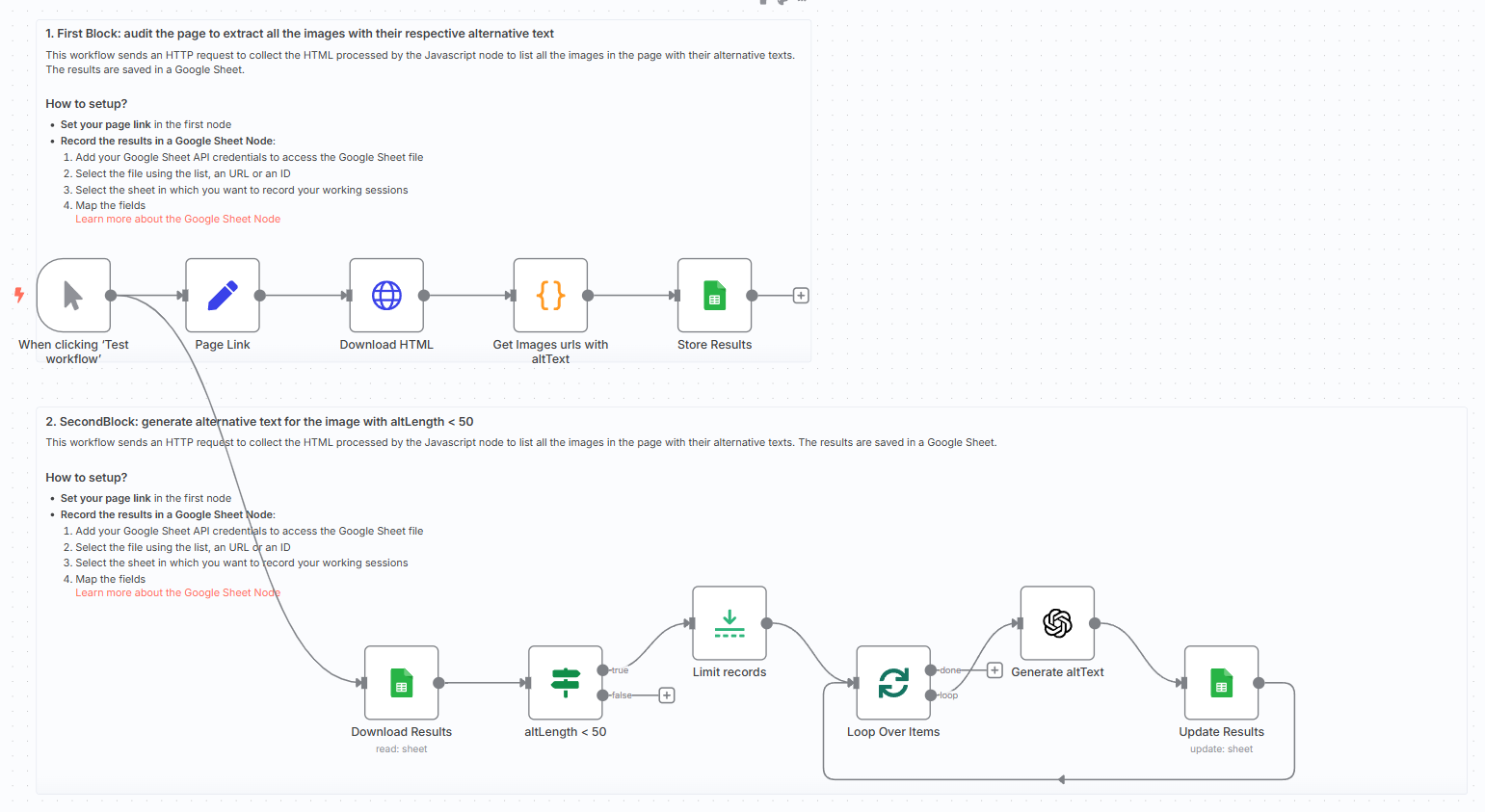
- Set a page URL using the
Setnode - Download HTML content
- Extract image
srcandaltusing aCodenode - Store results in a Google Sheet
- Filter images with
altLength < 50 - Send image URL to GPT-4o
- Update the Google Sheet with the newly generated
newAlttext
The AI alt texts are concise, descriptive, and accessibility-compliant.
What do I need to get started?
You’ll need:
- A Google Sheet to store the audit results
- An OpenAI account with GPT-4o access
Follow the Guide!
Follow the sticky notes in the workflow or check my tutorial to configure each node and start using AI to improve the accessibility of your website.
Notes
- GPT-generated alt texts are limited to ~125–150 characters for best results
- Use this to comply with WCAG and improve Google indexing
- Easily adapt it to audit multiple domains or e-commerce catalogues
This workflow was built using n8n version 1.85.4
Submitted: April 21, 2025
Improve Your Website Accessibility with GPT-4o and Google Sheets
This n8n workflow leverages the power of GPT-4o to analyze website content for accessibility issues and records the findings in a Google Sheet. It's designed to help web developers, content creators, and accessibility specialists quickly identify areas for improvement on their websites.
What it does
This workflow automates the process of checking website content for accessibility issues using AI:
- Manual Trigger: The workflow is initiated manually.
- Google Sheets: It reads a list of URLs and their corresponding content from a specified Google Sheet.
- Loop Over Items: It iterates through each row (website URL and content) retrieved from the Google Sheet.
- Edit Fields (Set): For each item, it prepares the data by setting the
textfield to the website content. - Code: It executes custom JavaScript code to construct a prompt for the OpenAI API, asking it to analyze the provided
textfor accessibility issues based on WCAG guidelines and suggest improvements. - OpenAI: It sends the prepared prompt to the OpenAI GPT-4o model to get an AI-generated accessibility report.
- Edit Fields (Set): It extracts the AI's response and assigns it to a new field,
aiResponse. - If: It checks if the
aiResponsefrom OpenAI contains any content.- If TRUE:
- Edit Fields (Set): It prepares the data for updating the Google Sheet, including the original URL and the AI-generated accessibility report.
- Google Sheets: It appends a new row to the Google Sheet with the URL and the accessibility report.
- If FALSE:
- Limit: It discards the item, effectively skipping rows where OpenAI did not return a response.
- If TRUE:
- Sticky Note: Provides a visual note within the workflow detailing the purpose of the OpenAI node.
Prerequisites/Requirements
To use this workflow, you will need:
- n8n Instance: A running n8n instance.
- Google Sheets Account: A Google account with access to Google Sheets.
- Google Sheets Credential: An n8n credential configured for Google Sheets (OAuth2 recommended).
- OpenAI Account: An OpenAI account with access to the GPT-4o model.
- OpenAI Credential: An n8n credential configured for OpenAI (API Key recommended).
- Google Sheet: A Google Sheet with at least two columns: one for website URLs and another for the content to be analyzed. The workflow expects the content to be in a column that can be mapped.
Setup/Usage
- Import the workflow: Download the provided JSON and import it into your n8n instance.
- Configure Credentials:
- Update the "Google Sheets" node (ID: 18) with your Google Sheets credential. Ensure it has access to the spreadsheet you intend to use.
- Update the "OpenAI" node (ID: 1250) with your OpenAI API Key credential.
- Prepare your Google Sheet:
- Create a new Google Sheet (or use an existing one).
- Ensure your sheet has at least two columns. For example,
URLandContent. - Populate the sheet with the URLs of the websites you want to analyze and the relevant content from those pages.
- Configure Google Sheets nodes:
- Google Sheets (Read) (ID: 18):
- Set the
Spreadsheet IDto your Google Sheet's ID. - Set the
Sheet Nameto the name of the sheet containing your data. - Ensure the
Read All Rowsoption is selected or configure a specific range if needed.
- Set the
- Google Sheets (Append) (ID: 18, second instance):
- Set the
Spreadsheet IDto your Google Sheet's ID. - Set the
Sheet Nameto the name of the sheet where you want to write the results (can be the same or a different sheet/tab). - Map the
URLandAI Responsefields to the appropriate columns in your Google Sheet.
- Set the
- Google Sheets (Read) (ID: 18):
- Configure the "Code" node (ID: 834):
- Review the JavaScript code to ensure the prompt for OpenAI aligns with your specific accessibility analysis needs.
- Make sure the
textvariable in the code correctly references the content retrieved from your Google Sheet (e.g.,item.json.Content).
- Activate the workflow: Once configured, activate the workflow.
- Execute the workflow: Click "Execute Workflow" on the "Manual Trigger" node to run the analysis. The results will be appended to your specified Google Sheet.
Related Templates
Track competitor SEO keywords with Decodo + GPT-4.1-mini + Google Sheets
This workflow automates competitor keyword research using OpenAI LLM and Decodo for intelligent web scraping. Who this is for SEO specialists, content strategists, and growth marketers who want to automate keyword research and competitive intelligence. Marketing analysts managing multiple clients or websites who need consistent SEO tracking without manual data pulls. Agencies or automation engineers using Google Sheets as an SEO data dashboard for keyword monitoring and reporting. What problem this workflow solves Tracking competitor keywords manually is slow and inconsistent. Most SEO tools provide limited API access or lack contextual keyword analysis. This workflow solves that by: Automatically scraping any competitor’s webpage with Decodo. Using OpenAI GPT-4.1-mini to interpret keyword intent, density, and semantic focus. Storing structured keyword insights directly in Google Sheets for ongoing tracking and trend analysis. What this workflow does Trigger — Manually start the workflow or schedule it to run periodically. Input Setup — Define the website URL and target country (e.g., https://dev.to, france). Data Scraping (Decodo) — Fetch competitor web content and metadata. Keyword Analysis (OpenAI GPT-4.1-mini) Extract primary and secondary keywords. Identify focus topics and semantic entities. Generate a keyword density summary and SEO strength score. Recommend optimization and internal linking opportunities. Data Structuring — Clean and convert GPT output into JSON format. Data Storage (Google Sheets) — Append structured keyword data to a Google Sheet for long-term tracking. Setup Prerequisites If you are new to Decode, please signup on this link visit.decodo.com n8n account with workflow editor access Decodo API credentials OpenAI API key Google Sheets account connected via OAuth2 Make sure to install the Decodo Community node. Create a Google Sheet Add columns for: primarykeywords, seostrengthscore, keyworddensity_summary, etc. Share with your n8n Google account. Connect Credentials Add credentials for: Decodo API credentials - You need to register, login and obtain the Basic Authentication Token via Decodo Dashboard OpenAI API (for GPT-4o-mini) Google Sheets OAuth2 Configure Input Fields Edit the “Set Input Fields” node to set your target site and region. Run the Workflow Click Execute Workflow in n8n. View structured results in your connected Google Sheet. How to customize this workflow Track Multiple Competitors → Use a Google Sheet or CSV list of URLs; loop through them using the Split In Batches node. Add Language Detection → Add a Gemini or GPT node before keyword analysis to detect content language and adjust prompts. Enhance the SEO Report → Expand the GPT prompt to include backlink insights, metadata optimization, or readability checks. Integrate Visualization → Connect your Google Sheet to Looker Studio for SEO performance dashboards. Schedule Auto-Runs → Use the Cron Node to run weekly or monthly for competitor keyword refreshes. Summary This workflow automates competitor keyword research using: Decodo for intelligent web scraping OpenAI GPT-4.1-mini for keyword and SEO analysis Google Sheets for live tracking and reporting It’s a complete AI-powered SEO intelligence pipeline ideal for teams that want actionable insights on keyword gaps, optimization opportunities, and content focus trends, without relying on expensive SEO SaaS tools.
 By Ranjan Dailata
Generate song lyrics and music from text prompts using OpenAI and Fal.ai Minimax
Spark your creativity instantly in any chat—turn a simple prompt like "heartbreak ballad" into original, full-length lyrics and a professional AI-generated music track, all without leaving your conversation. 📋 What This Template Does This chat-triggered workflow harnesses AI to generate detailed, genre-matched song lyrics (at least 600 characters) from user messages, then queues them for music synthesis via Fal.ai's minimax-music model. It polls asynchronously until the track is ready, delivering lyrics and audio URL back in chat. Crafts original, structured lyrics with verses, choruses, and bridges using OpenAI Submits to Fal.ai for melody, instrumentation, and vocals aligned to the style Handles long-running generations with smart looping and status checks Returns complete song package (lyrics + audio link) for seamless sharing 🔧 Prerequisites n8n account (self-hosted or cloud with chat integration enabled) OpenAI account with API access for GPT models Fal.ai account for AI music generation 🔑 Required Credentials OpenAI API Setup Go to platform.openai.com → API keys (sidebar) Click "Create new secret key" → Name it (e.g., "n8n Songwriter") Copy the key and add to n8n as "OpenAI API" credential type Test by sending a simple chat completion request Fal.ai HTTP Header Auth Setup Sign up at fal.ai → Dashboard → API Keys Generate a new API key → Copy it In n8n, create "HTTP Header Auth" credential: Name="Fal.ai", Header Name="Authorization", Header Value="Key [Your API Key]" Test with a simple GET to their queue endpoint (e.g., /status) ⚙️ Configuration Steps Import the workflow JSON into your n8n instance Assign OpenAI API credentials to the "OpenAI Chat Model" node Assign Fal.ai HTTP Header Auth to the "Generate Music Track", "Check Generation Status", and "Fetch Final Result" nodes Activate the workflow—chat trigger will appear in your n8n chat interface Test by messaging: "Create an upbeat pop song about road trips" 🎯 Use Cases Content Creators: YouTubers generating custom jingles for videos on the fly, streamlining production from idea to audio export Educators: Music teachers using chat prompts to create era-specific folk tunes for classroom discussions, fostering interactive learning Gift Personalization: Friends crafting anniversary R&B tracks from shared memories via quick chats, delivering emotional audio surprises Artist Brainstorming: Songwriters prototyping hip-hop beats in real-time during sessions, accelerating collaboration and iteration ⚠️ Troubleshooting Invalid JSON from AI Agent: Ensure the system prompt stresses valid JSON; test the agent standalone with a sample query Music Generation Fails (401/403): Verify Fal.ai API key has minimax-music access; check usage quotas in dashboard Status Polling Loops Indefinitely: Bump wait time to 45-60s for complex tracks; inspect fal.ai queue logs for bottlenecks Lyrics Under 600 Characters: Tweak agent prompt to enforce fuller structures like [V1][C][V2][B][C]; verify output length in executions
 By Daniel Nkencho
Automate invoice processing with OCR, GPT-4 & Salesforce opportunity creation
PDF Invoice Extractor (AI) End-to-end pipeline: Watch Drive ➜ Download PDF ➜ OCR text ➜ AI normalize to JSON ➜ Upsert Buyer (Account) ➜ Create Opportunity ➜ Map Products ➜ Create OLI via Composite API ➜ Archive to OneDrive. --- Node by node (what it does & key setup) 1) Google Drive Trigger Purpose: Fire when a new file appears in a specific Google Drive folder. Key settings: Event: fileCreated Folder ID: google drive folder id Polling: everyMinute Creds: googleDriveOAuth2Api Output: Metadata { id, name, ... } for the new file. --- 2) Download File From Google Purpose: Get the file binary for processing and archiving. Key settings: Operation: download File ID: ={{ $json.id }} Creds: googleDriveOAuth2Api Output: Binary (default key: data) and original metadata. --- 3) Extract from File Purpose: Extract text from PDF (OCR as needed) for AI parsing. Key settings: Operation: pdf OCR: enable for scanned PDFs (in options) Output: JSON with OCR text at {{ $json.text }}. --- 4) Message a model (AI JSON Extractor) Purpose: Convert OCR text into strict normalized JSON array (invoice schema). Key settings: Node: @n8n/n8n-nodes-langchain.openAi Model: gpt-4.1 (or gpt-4.1-mini) Message role: system (the strict prompt; references {{ $json.text }}) jsonOutput: true Creds: openAiApi Output (per item): $.message.content → the parsed JSON (ensure it’s an array). --- 5) Create or update an account (Salesforce) Purpose: Upsert Buyer as Account using an external ID. Key settings: Resource: account Operation: upsert External Id Field: taxid_c External Id Value: ={{ $json.message.content.buyer.tax_id }} Name: ={{ $json.message.content.buyer.name }} Creds: salesforceOAuth2Api Output: Account record (captures Id) for downstream Opportunity. --- 6) Create an opportunity (Salesforce) Purpose: Create Opportunity linked to the Buyer (Account). Key settings: Resource: opportunity Name: ={{ $('Message a model').item.json.message.content.invoice.code }} Close Date: ={{ $('Message a model').item.json.message.content.invoice.issue_date }} Stage: Closed Won Amount: ={{ $('Message a model').item.json.message.content.summary.grand_total }} AccountId: ={{ $json.id }} (from Upsert Account output) Creds: salesforceOAuth2Api Output: Opportunity Id for OLI creation. --- 7) Build SOQL (Code / JS) Purpose: Collect unique product codes from AI JSON and build a SOQL query for PricebookEntry by Pricebook2Id. Key settings: pricebook2Id (hardcoded in script): e.g., 01sxxxxxxxxxxxxxxx Source lines: $('Message a model').first().json.message.content.products Output: { soql, codes } --- 8) Query PricebookEntries (Salesforce) Purpose: Fetch PricebookEntry.Id for each Product2.ProductCode. Key settings: Resource: search Query: ={{ $json.soql }} Creds: salesforceOAuth2Api Output: Items with Id, Product2.ProductCode (used for mapping). --- 9) Code in JavaScript (Build OLI payloads) Purpose: Join lines with PBE results and Opportunity Id ➜ build OpportunityLineItem payloads. Inputs: OpportunityId: ={{ $('Create an opportunity').first().json.id }} Lines: ={{ $('Message a model').first().json.message.content.products }} PBE rows: from previous node items Output: { body: { allOrNone:false, records:[{ OpportunityLineItem... }] } } Notes: Converts discount_total ➜ per-unit if needed (currently commented for standard pricing). Throws on missing PBE mapping or empty lines. --- 10) Create Opportunity Line Items (HTTP Request) Purpose: Bulk create OLIs via Salesforce Composite API. Key settings: Method: POST URL: https://<your-instance>.my.salesforce.com/services/data/v65.0/composite/sobjects Auth: salesforceOAuth2Api (predefined credential) Body (JSON): ={{ $json.body }} Output: Composite API results (per-record statuses). --- 11) Update File to One Drive Purpose: Archive the original PDF in OneDrive. Key settings: Operation: upload File Name: ={{ $json.name }} Parent Folder ID: onedrive folder id Binary Data: true (from the Download node) Creds: microsoftOneDriveOAuth2Api Output: Uploaded file metadata. --- Data flow (wiring) Google Drive Trigger → Download File From Google Download File From Google → Extract from File → Update File to One Drive Extract from File → Message a model Message a model → Create or update an account Create or update an account → Create an opportunity Create an opportunity → Build SOQL Build SOQL → Query PricebookEntries Query PricebookEntries → Code in JavaScript Code in JavaScript → Create Opportunity Line Items --- Quick setup checklist 🔐 Credentials: Connect Google Drive, OneDrive, Salesforce, OpenAI. 📂 IDs: Drive Folder ID (watch) OneDrive Parent Folder ID (archive) Salesforce Pricebook2Id (in the JS SOQL builder) 🧠 AI Prompt: Use the strict system prompt; jsonOutput = true. 🧾 Field mappings: Buyer tax id/name → Account upsert fields Invoice code/date/amount → Opportunity fields Product name must equal your Product2.ProductCode in SF. ✅ Test: Drop a sample PDF → verify: AI returns array JSON only Account/Opportunity created OLI records created PDF archived to OneDrive --- Notes & best practices If PDFs are scans, enable OCR in Extract from File. If AI returns non-JSON, keep “Return only a JSON array” as the last line of the prompt and keep jsonOutput enabled. Consider adding validation on parsing.warnings to gate Salesforce writes. For discounts/taxes in OLI: Standard OLI fields don’t support per-line discount amounts directly; model them in UnitPrice or custom fields. Replace the Composite API URL with your org’s domain or use the Salesforce node’s Bulk Upsert for simplicity.
 By Le Nguyen